

Every successful business eventually reaches a point where leadership must decide whether to continue relying on a single source of income or build additional revenue streams. While growing a primary business is essential, long-term stability often depends on business diversification the strategic creation of multiple profit centers that support the company’s mission and strengthen its financial future.
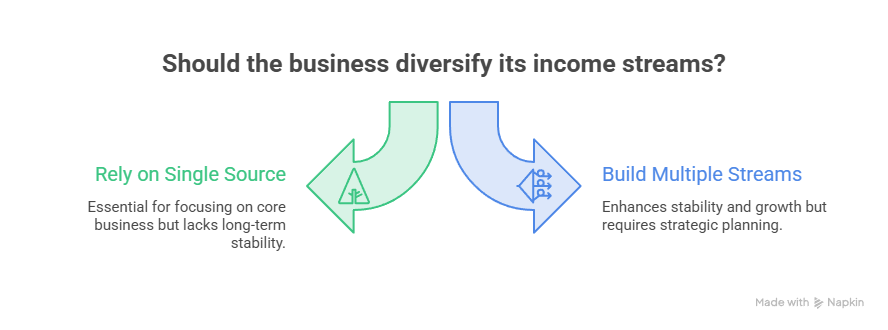
However, diversification should never come at the expense of your existing business. One of the biggest mistakes entrepreneurs make is abandoning a profitable business to chase an entirely different opportunity before their current operation is fully established.
Successful business expansion isn’t about chasing every opportunity. It’s about protecting your core business while strategically creating new avenues for sustainable growth.
Stay in Your Lane Before Creating New Ones
Many entrepreneurs become distracted by exciting business opportunities they hear about from friends, colleagues, or social media.
Someone shares their success story.
A new industry appears profitable.
A trending business promises quick wealth.
The temptation to change direction can be strong.
However, leaving a business that already has momentum to pursue an unfamiliar opportunity often creates unnecessary financial risk.
A successful business generates momentum through years of customer trust, operational improvements, marketing, and consistent execution. Walking away from that momentum before it reaches maturity can quickly reduce revenue and profitability.
Before entering a completely different business, ask yourself:
- Do I truly understand this industry?
- Can I financially support a new venture until it becomes profitable?
- Will this distract me from my existing business?
- Does this opportunity align with my long-term vision?
In many cases, the smartest decision is not changing lanes—but strengthening the one you’re already driving in.
Momentum Is One of Your Greatest Business Assets
Momentum is difficult to build but easy to lose.
When your marketing, customer relationships, reputation, and sales systems are working together, your business begins generating consistent results.
If leadership suddenly diverts its attention toward an unrelated venture, the primary business often begins slowing down.
Customers receive less attention.
Marketing becomes inconsistent.
Operations lose focus.
Sales decline.
Revenue drops.
Protecting existing momentum should always remain the highest priority while planning future expansion.
Why Business Diversification Matters
Although abandoning a successful business is risky, relying on only one source of income creates another type of risk.
Markets change.
Customer demand shifts.
Economic conditions fluctuate.
Technology evolves.
A business with only one revenue stream is more vulnerable during difficult economic periods.
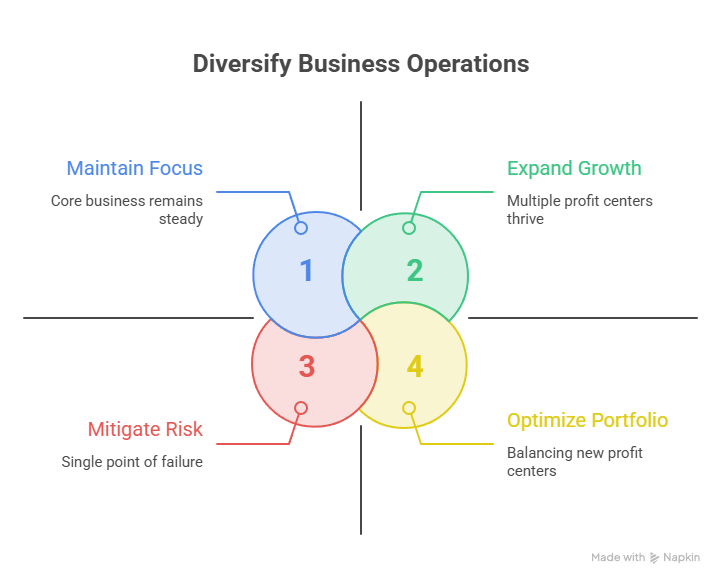
Business diversification reduces this risk by creating multiple profit centers that complement one another and strengthen overall business performance.
Additional profit centers provide financial stability while allowing organizations to serve customers more comprehensively.
What Is a Profit Center?
A profit center is a product, service, department, or business unit that independently generates revenue and contributes to the organization’s overall profitability.
Examples include:
- Additional services
- Complementary products
- New business locations
- Subscription programs
- Training services
- Consulting divisions
- Maintenance programs
- Premium service packages
Each profit center should strengthen—not compete with—your primary business.
The strongest organizations create multiple profit centers that naturally support one another.
Choose Profit Centers That Create Synergy
Not every new business idea deserves investment.
The best profit centers complement your existing business and create additional value for your customers.
Ask yourself:
- Do customers already request this service?
- Does it solve another problem for existing clients?
- Can it strengthen customer loyalty?
- Does it improve our overall brand?
- Can it share existing resources without disrupting operations?
Businesses grow more efficiently when new services naturally fit within their existing mission.
This creates operational synergy.
Customers receive greater value.
Employees become more productive.
Marketing becomes easier.
Revenue increases across multiple business areas.
Listen to Your Customers
One of the simplest ways to identify new profit centers is to pay attention to customer demand.
When customers repeatedly ask:
- “Do you also provide this service?”
- “Can you help us with this?”
- “Do you offer another solution?”
They are often identifying your next business opportunity.
Rather than guessing what the market wants, successful entrepreneurs allow customer demand to guide expansion decisions.
Before making a significant investment, pilot the service on a small scale to measure demand, profitability, and operational requirements.
Never Weaken Your Existing Business
One of the most common expansion mistakes occurs when business owners transfer their best employees from an established operation to launch a new venture.
Although this may seem logical, it often creates problems in both businesses.
The existing business loses experienced personnel.
Customer service declines.
Productivity decreases.
The new business struggles because it lacks sufficient staffing.
Instead, recruit and train new employees specifically for the new profit center.
Allow experienced team members to mentor them without disrupting the momentum of your existing operation.
Growth should strengthen your business—not divide it.
Give New Profit Centers Time to Build Momentum
Every new business initiative requires time before becoming profitable.
New customers must discover your services.
Employees require training.
Systems need refinement.
Marketing campaigns gain traction gradually.
One of the biggest leadership responsibilities is accurately estimating how long it will take a new profit center to become self-sustaining.
Businesses that underestimate this timeline often abandon promising opportunities too early.
At the same time, leaders should avoid continuing investments indefinitely when objective performance data indicates the venture is unlikely to succeed.
Patience should always be balanced with measurable performance.
Measure Success Before Scaling
Every new profit center should be treated like a pilot project before significant expansion.
Measure important business metrics such as:
- Revenue
- Gross profit margin
- Customer demand
- Customer satisfaction
- Operating costs
- Productivity
- Cash flow
- Return on investment
If the pilot consistently demonstrates profitability and customer demand, expand with confidence.
If performance remains weak after sustained effort and refinement, redirect resources toward stronger opportunities.
Successful entrepreneurs know when to persevere—and when to move on.
Align Every Profit Center with Your Mission
Diversification should never confuse your organization’s identity.
Every new service, product, or location should support your company’s overall purpose.
Customers should immediately understand how the new offering fits within your brand.
Employees should clearly understand why the new initiative matters.
Organizations with a strong, unified mission experience greater employee engagement, stronger customer loyalty, and more consistent long-term growth.
Purpose creates alignment.
Alignment creates momentum.
Momentum drives expansion.
Choose Leaders with High Motivation
Launching a new profit center requires more than technical knowledge.
It requires determination, resilience, and leadership.
Every new venture experiences obstacles.
Sales may begin slowly.
Processes require improvement.
Unexpected problems will arise.
The person responsible for building the new operation must possess exceptional motivation, persistence, and commitment.
Highly motivated leaders continue improving until the business gains stable momentum.
Their determination often becomes the deciding factor between success and failure.
Best Practices for Business Diversification
When expanding your business, follow these proven principles:
- Build a strong core business before diversifying.
- Aim to develop multiple complementary profit centers over time.
- Choose opportunities based on proven customer demand.
- Pilot every new product or service before scaling.
- Maintain or exceed your existing profit margins.
- Train dedicated staff for new business units instead of weakening existing operations.
- Establish clear systems, processes, and performance metrics.
- Monitor key performance indicators (KPIs) regularly.
- Shut down underperforming ventures before they consume excessive resources.
- Ensure every new profit center aligns with your company’s mission and long-term strategy.
Common Mistakes to Avoid
Many diversification efforts fail because businesses:
- Chase trends instead of solving customer problems.
- Expand too quickly.
- Underestimate startup costs.
- Ignore profitability.
- Divert attention from successful operations.
- Move experienced staff away from core business activities.
- Fail to test demand before investing heavily.
- Continue funding unsuccessful ventures for too long.
Avoiding these mistakes significantly improves the likelihood of successful expansion.
Final Thoughts
Business diversification is one of the most effective strategies for building long-term stability and sustainable growth. However, successful diversification requires discipline, careful planning, and a commitment to protecting the momentum of your core business.
The strongest organizations don’t chase every opportunity—they build complementary profit centers that align with their mission, meet customer demand, and strengthen existing operations.
When implemented strategically, multiple profit centers reduce financial risk, increase profitability, create new career opportunities, and position businesses for long-term success regardless of changing market conditions.
Grow your primary business.
Protect its momentum.
Then expand thoughtfully with profit centers that create lasting value for your customers, your employees, and your organization.
Frequently Asked Questions
1. What is business diversification?
Business diversification is the strategy of expanding a company by adding complementary products, services, markets, or profit centers to reduce financial risk and create multiple sources of revenue.
2. What is a profit center?
A profit center is a business unit, product, or service that generates its own revenue and contributes directly to a company’s profitability. Multiple profit centers help improve financial stability and support long-term business growth.
3. Why is it important to diversify a business?
Diversifying a business reduces dependence on a single income source, minimizes financial risk, creates new growth opportunities, strengthens market competitiveness, and helps businesses remain resilient during economic changes.
4. How do I know if a new profit center is worth adding?
A new profit center should solve a genuine customer need, align with your company’s mission, complement your existing services, demonstrate strong profit potential, and perform successfully during a pilot phase before full-scale implementation.
5. What are the biggest mistakes businesses make when diversifying?
Common mistakes include abandoning a successful core business too early, chasing trends without market demand, failing to test profitability, transferring key employees away from existing operations, underestimating startup costs, and continuing unsuccessful ventures for too long.
No matter where you are in your business journey, you don’t have to navigate it alone. At SBM Business Centers, we are committed to helping business owners think like executives, build stronger companies, and create lasting success. If you would like to learn how we can help your business grow, schedule a complimentary business analysis and consultation with Vida Puodziunas by calling 813-906-0477. We look forward to partnering with you and helping you build the business you’ve always envisioned.