

Many business owners begin their journey as skilled technicians. They excel at delivering products or services, solving problems, and working hard to achieve results. While these technical abilities are valuable, they are not enough to build a business that grows sustainably. As a business expands, success depends less on personal effort and more on strategic leadership. This is where developing an executive mindset becomes essential.
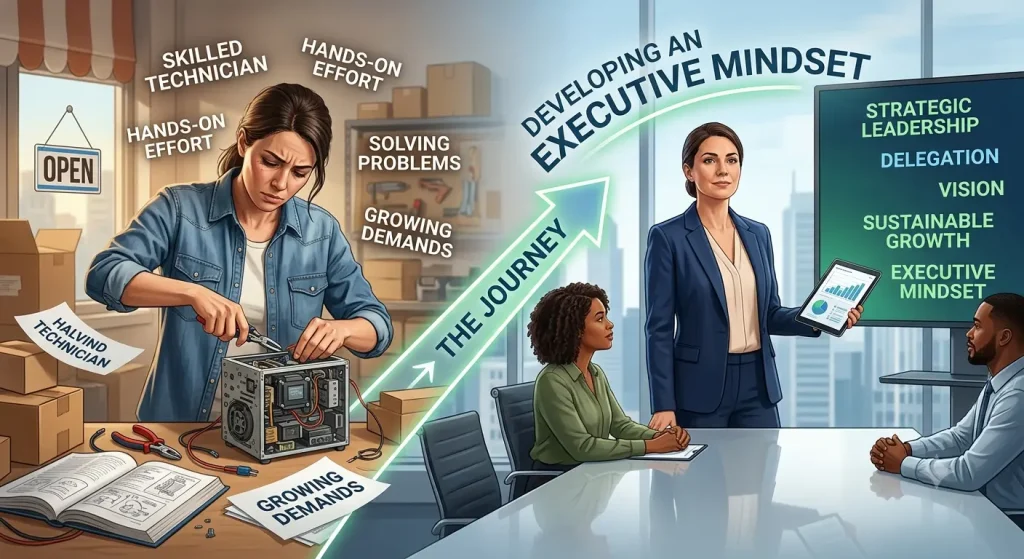
An executive mindset is not defined by a job title. It is a way of thinking that focuses on measurable outcomes, strategic planning, financial awareness, and long-term business viability. Executives make decisions based on data, trends, and forecasts rather than emotions or opinions. They build systems, empower people, and focus on improving business performance instead of personally completing every task.
Transitioning from a technician mindset to an executive mindset requires consistent daily habits and a commitment to making decisions supported by numbers.
Technician Mindset vs. Executive Mindset
The first step in developing executive thinking is understanding the fundamental differences between the two approaches.
A technician operates from experience and personal knowledge. They rely on their own skills to solve problems and often measure success by how well they perform their work. They tend to increase their own workload to improve results and frequently seek validation through recognition and praise.
An executive, however, asks a different question: “What do the numbers say?” Every decision begins with measurable data. Rather than solving every problem personally, executives determine which work should be completed, assign responsibility to capable people, and evaluate performance through statistics, trends, and business outcomes.
Technicians work in the business.
Executives work on the business.
This distinction is the foundation of scalable leadership.
Why Most Business Owners Remain Technicians
Many entrepreneurs unknowingly stay trapped in the technician mindset because their businesses were built on their personal expertise. As the business grows, they continue doing the work themselves instead of creating systems that allow others to perform consistently.
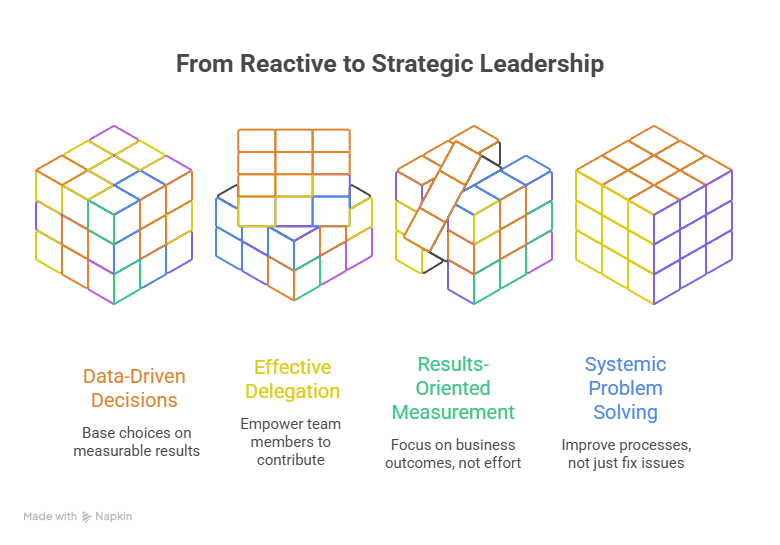
Common characteristics include:
- Making decisions based on intuition instead of measurable data.
- Becoming overwhelmed because they refuse to delegate.
- Measuring effort rather than business results.
- Solving problems individually instead of improving systems.
- Reacting to daily issues instead of planning strategically.
Breaking these habits is necessary for long-term growth.
Why Numbers Matter More Than Opinions
One of the defining characteristics of an executive mindset is the ability to make objective decisions using measurable information.
Opinions often change depending on emotions or personal experiences. Numbers provide clarity.
Successful executives regularly monitor key performance indicators (KPIs), financial reports, productivity metrics, revenue trends, profit margins, customer satisfaction, and operational efficiency. These metrics reveal whether the business is improving or declining and provide a factual basis for making decisions.
The first executive rule is simple:
No discussion, decision, or opinion is valid without accurate numbers to support it.
When numbers become the foundation of decision-making, emotional reactions decrease and strategic thinking improves.
Build Confidence with Business Mathematics
Many people avoid financial analysis because mathematics was difficult during school. However, executives do not need advanced mathematics to lead effectively. A solid understanding of arithmetic and basic financial calculations is often enough.
Executives should understand concepts such as:
- Revenue
- Cost of goods sold
- Gross profit
- Operating expenses
- Net profit
- Profit margins
- Financial statements
- Business dashboards
Understanding these numbers provides confidence when evaluating business performance and planning future growth.
Leadership Requires Giving and Receiving Clear Direction
Executives must be comfortable giving and receiving instructions.
Many technicians struggle with delegation because they believe no one else can perform the work as well as they can. Unfortunately, this limits business growth and creates dependency on one individual.
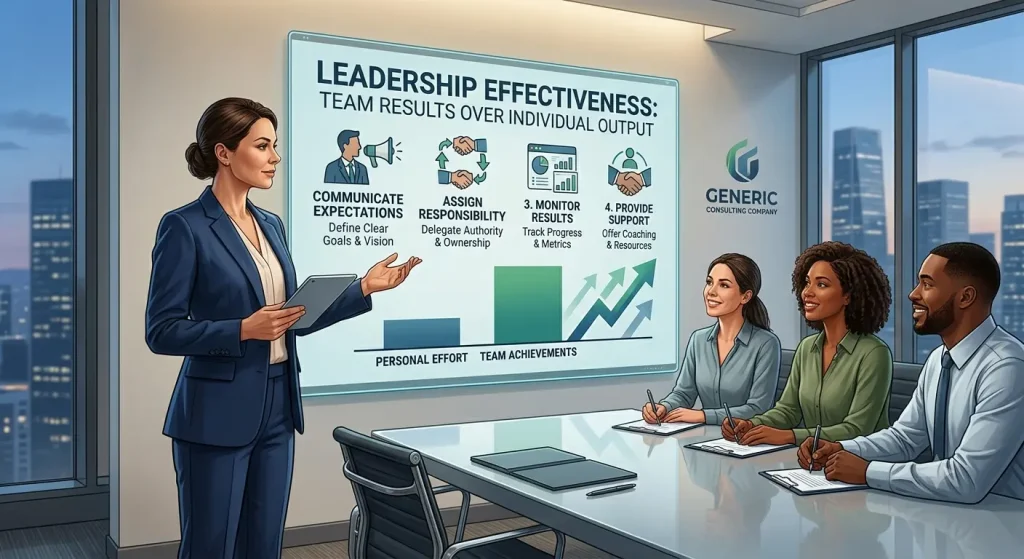
Effective executives clearly communicate expectations, assign responsibility, monitor results, and provide support when necessary. Leadership is measured not by how much work an executive completes personally but by how effectively the team achieves results.
The Five-Step Framework for Developing an Executive Mindset
Step 1: Turn Every Problem into Measurable Data
Replace vague descriptions such as “busy,” “slow,” or “better” with measurable statistics.
Instead of saying:
“The system is slow.”
Say:
“The system creates a 17% processing delay, costing four labor hours every day based on the last five weeks of data.”
Measuring performance creates objective thinking.
Step 2: Take Ownership of One Critical Business Metric
Executives focus on improving key business indicators rather than trying to manage everything simultaneously.
Examples include:
- Revenue per employee
- Cost per project
- Gross profit margin
- Customer retention
- Production output
- Error rates
- Cycle time
Every week ask three questions:
- Is the number increasing or decreasing?
- Why has it changed?
- What action will improve it?
These simple questions develop executive thinking.
Step 3: Make Decisions Based on Trends
Technicians often react to isolated events.
Executives study trends.
Tracking at least five consecutive data points allows leaders to recognize patterns and make informed decisions instead of reacting emotionally to one difficult week.
A weekly performance chart quickly reveals whether productivity, revenue, or profitability is improving or declining.
Trend analysis leads to better forecasting and more confident leadership.
Step 4: Predict Outcomes Before Taking Action
Executives do not simply act and hope for the best.
Before implementing any decision, they ask:
“What result do we expect, and how much improvement should this create?”
Prediction develops strategic thinking and strengthens financial awareness. After implementation, results are compared against expectations, allowing continuous improvement.
Step 5: Observe Systems Instead of Performing Every Task
As businesses grow, executives reduce their involvement in day-to-day operations while increasing their observation of business systems.
Weekly reports should answer four questions:
- What happened?
- What changed?
- What does it mean?
- What action should follow?
Executives approve solutions rather than personally completing every task.
Why Five Data Points Matter
One or two observations rarely provide enough information to make confident decisions.
Five consecutive data points reveal meaningful trends.
For example, if weekly production declines from 120 jobs to 96 jobs over five weeks while labor hours remain unchanged, the business has experienced a significant reduction in productivity.
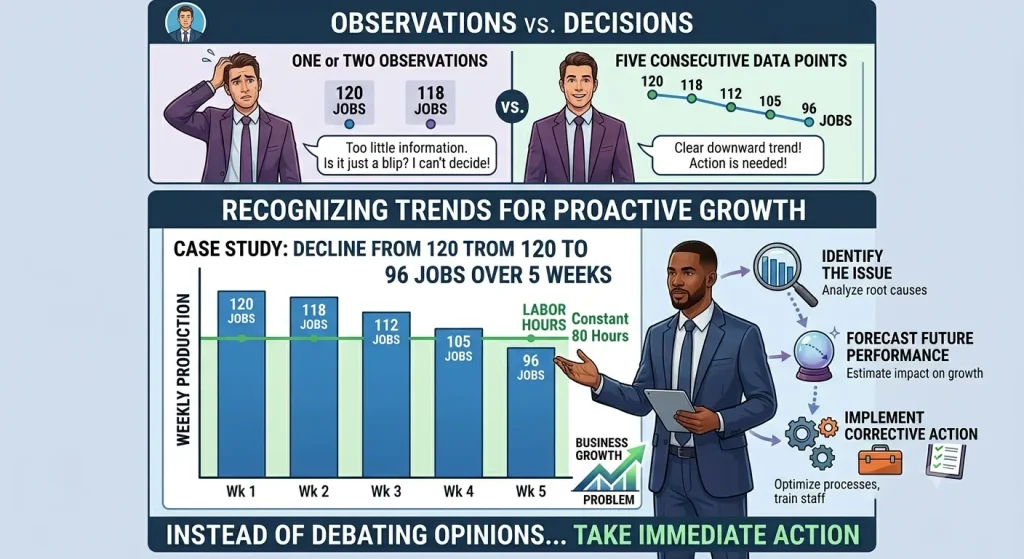
Instead of debating opinions, executives immediately identify the issue, forecast future performance, and implement corrective action.
Business growth depends on recognizing trends before they become serious problems.
Build Executive Habits Every Day
Developing an executive mindset is not an overnight transformation. It is built through consistent daily practices.
Successful executives review business metrics every day, monitor weekly performance reports, evaluate monthly financial results, forecast future performance, and continuously improve systems.
Over time, these habits replace emotional decision-making with objective leadership.
A Real-Life Lesson in Executive Thinking
My own executive mindset was developed during five years working in a publicly listed company where performance was measured almost entirely through numbers.
Each week, management reviewed gross revenue, cost of goods sold, gross profit, operating expenses, and net profit. Excuses carried little value. Instead, leadership wanted to know what actions were already underway to restore performance.
Rather than asking why results declined, they asked what strategy would improve them.
That experience fundamentally changed how I approached business.
When I later built my own companies, I consistently targeted a minimum 30 percent net profit because that benchmark had become deeply embedded in my thinking. Businesses that could not achieve acceptable profitability were quickly restructured or replaced with stronger opportunities.
Those years taught me that executive thinking is developed through disciplined exposure to measurable business performance, not personal opinion.
The 90-Day Executive Mindset Challenge
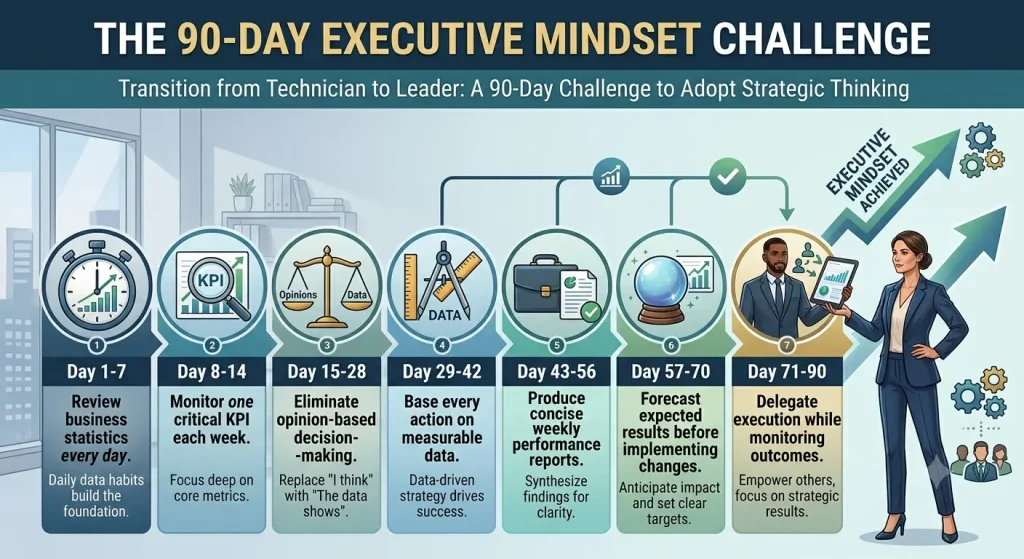
If you want to transition from a technician mindset to an executive mindset, commit to these habits for the next 90 days:
- Review business statistics every day.
- Monitor one critical KPI each week.
- Eliminate opinion-based decision-making.
- Base every action on measurable data.
- Produce concise weekly performance reports.
- Forecast expected results before implementing changes.
- Delegate execution while monitoring outcomes.
Most people begin thinking differently within 30 to 60 days when these habits become part of their routine.
Final Thoughts
An executive mindset is not inherited, and it is not reserved for CEOs. It is developed through disciplined thinking, measurable decision-making, and consistent leadership habits.
When opinions are replaced with facts, when trends replace assumptions, and when systems replace personal effort, business performance improves dramatically.
Always remember:
An executive thinks with numbers. A technician thinks with experience.
The sooner you begin making decisions based on measurable data, the sooner you will lead with greater confidence, improve business performance, and create a business that can grow beyond your personal effort.
Frequently Asked Questions
1. What is an executive mindset?
An executive mindset is a strategic way of thinking that focuses on making business decisions based on data, measurable results, and long-term objectives rather than personal opinions or emotions. Executives prioritize business growth, profitability, leadership, and system improvement to achieve sustainable success.
2. How can I transition from a technician mindset to an executive mindset?
The transition begins by shifting your focus from doing the work yourself to managing business performance through key metrics and strategic planning. Start by tracking important business statistics, making data-driven decisions, delegating responsibilities, reviewing trends regularly, and focusing on improving systems instead of handling every task personally.
3. Why is data-driven decision-making important for executives?
Data-driven decision-making removes guesswork and emotion from business management. By analyzing key performance indicators (KPIs), financial reports, productivity metrics, and business trends, executives can identify opportunities, solve problems proactively, forecast future outcomes, and make informed decisions that improve profitability and long-term business success.
4. What business metrics should every executive monitor?
Every executive should regularly monitor the key metrics that directly impact business performance, including revenue, gross profit, net profit, cash flow, operating expenses, customer acquisition cost, customer retention rate, productivity, employee performance, and overall profitability. Tracking these metrics helps identify trends and supports better strategic decisions.
5. Can anyone develop an executive mindset?
Yes. An executive mindset is a learned skill rather than an inborn talent. With consistent practice, anyone can develop executive thinking by reviewing business data daily, setting measurable goals, forecasting outcomes, delegating effectively, and making decisions based on facts instead of assumptions. Over time, these habits become second nature and lead to stronger leadership and better business results.
If you have any additional questions or if you would like to take our business assessment, contact Vida Puodziunas at 813-906-0477.