

When an organization starts to implode, the first sign is rarely a bad balance sheet. It is people. Staff start attacking each other, rumors spread, and you get the witch-hunt dynamic — this person did this, that person did that — while one or two leaders at the helm scramble to keep the whole thing running. What is actually happening underneath all of it is simpler than it looks: people have quietly stopped taking responsibility for the organization and started taking responsibility only for themselves.
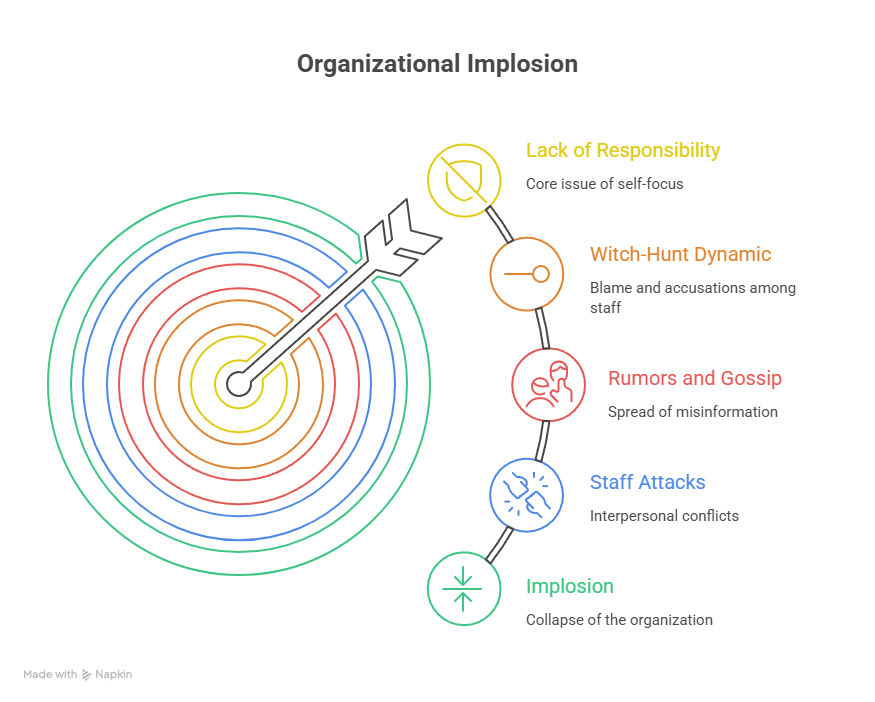
This article lays out a practical organizational turnaround strategy built around that single insight — covering the early warning signs of decline, why personal agendas crowd out a company’s vision, and the team alignment and shared-purpose work that reliably pulls a struggling organization back from the edge.
The Early Warning Signs of Organizational Decline
Infighting almost always shows up before the financials do. Gossip, scapegoating, and turf wars are a leading indicator, not a side issue — they are what it looks like when people redirect energy away from the mission and toward protecting themselves. By the time stats are declining, income is dropping, and debt is piling up, the cultural damage has usually been building for months.
The largest, fastest-growing organizations look almost the opposite: everyone in them is pushing the same vision and mission in the same direction. The moment an individual’s personal agenda starts functioning as the unofficial standard operating procedure — when “what’s good for me” quietly replaces “what’s good for the company” — that is the inflection point where expansion turns into contraction.
Why Personal Agendas Quietly Replace the Company Vision
This shift rarely happens all at once, and it is almost never announced. It happens gradually, in small decisions, when leadership stops actively reinforcing why the organization exists. A shared purpose that is not continually restated does not stay neutral — it gets replaced, because people will always default to optimizing for something, and in the absence of a clear collective “why,” that something becomes their own comfort, territory, or ego.
There is a related pattern worth naming directly: an individual who starts a business to support themselves and their family often hits a wall the moment that original goal is achieved. Once personal financial security is secured, growth can stall unless the purpose evolves into something bigger than the founder’s own needs. The same mechanic that derails a whole organization — personal agenda quietly overtaking shared purpose — plays out inside a single founder’s head, too.
The Turnaround Strategy: Getting Back to “What Are We Doing Here?”
Healing a fractured group usually starts with individuals, not policies. People drift into protecting their own interests; reversing that means deliberately strengthening the group again, clarifying the purpose and vision, and being honest about who genuinely wants to be part of that purpose going forward. Some people will not, and that is a legitimate outcome of the process, not a failure of it.
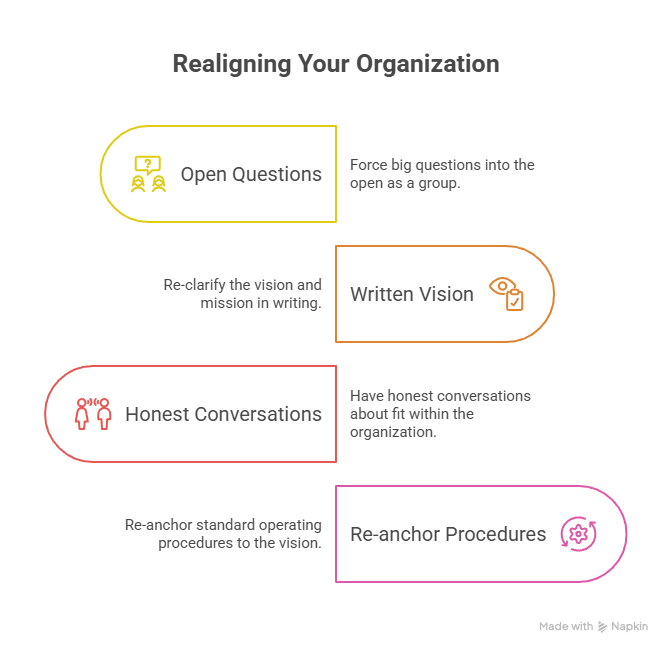
In practice, this organizational turnaround strategy comes down to a handful of concrete moves:
- Force the big questions into the open, as a group. What are we actually doing here? Are we making a real difference in our environment? Or are we absorbed in our own games and criticisms, unable to see the bigger picture?
- Re-clarify the vision and mission in writing. Verbal alignment fades fast; a written, specific statement of purpose gives people something concrete to measure their own behavior against.
- Have honest conversations about fit. Not everyone currently in the organization will want to re-commit to the clarified purpose, and that needs to be okay on both sides.
- Re-anchor standard operating procedures to the vision, not to convenience. Processes that quietly serve individual comfort over the mission are exactly what let personal agendas take root in the first place.
This kind of reset is often described as a “come to Jesus” moment for a reason — it only works if it is direct, uncomfortable, and honest rather than diplomatic to the point of avoiding the real issue.
Using a Big, Shared Goal to Rally the Team: The Inc. 5000 Example
One of the most effective tools for team alignment is giving a fragmented group an external, credible, hard-to-fake target to chase together. With companies I work with, I often use the Inc. 5000 — Inc. Magazine’s annual ranking of the 5,000 fastest-growing privately held companies in the U.S. — as exactly that kind of rallying point.
It is worth being precise about what the list actually rewards, since the mechanics matter for how teams should think about the goal. Inc. 5000 companies are ranked by percentage revenue growth across a three-year window, not by a single year’s performance. On the most recent list, the median honoree had grown revenue by roughly 169 percent over that three-year period; the companies that crack the top 500 typically post growth rates in the high hundreds of percent or more across the same window.
The exact numbers matter less than the underlying lesson: getting onto a list like this is never a one-person achievement. It takes the whole team — delivery, marketing, financial management, personnel — pulling in the same direction over a sustained period, with purpose as the thread connecting all of it. The organization’s purpose has to be continually pushed, or people drift back into playing their own individual games. A goal like this works as a turnaround tool precisely because it is too big for any one department’s politics to hijack.
Unity Under Pressure: The “Heal or Die” Lesson from Team Sports
There is a moment in Any Given Sunday where Al Pacino’s character, a football coach trying to pull a struggling team back together, tells them: “Either we heal, now, as a team, or we will die as individuals.” It is a blunt way of saying something genuinely true about organizations: the choice is rarely between growth and stability. It is between healing together or declining separately.
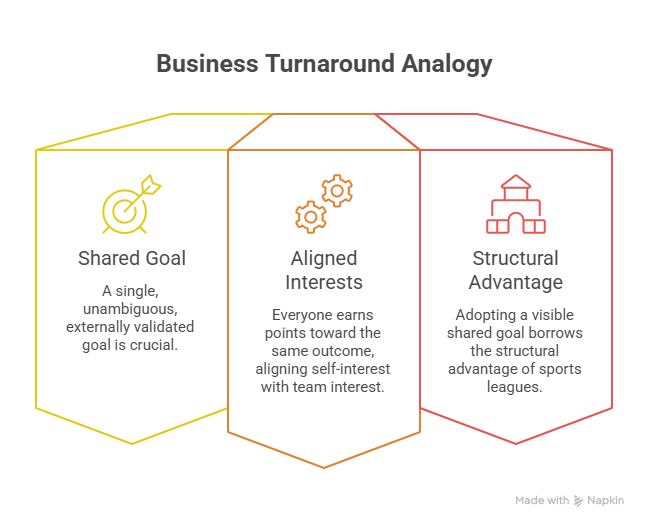
Sports analogies hold up in business turnarounds for a specific reason — every league hands its teams the same thing an organization in crisis is usually missing: one unambiguous, shared, externally validated goal. Make the playoffs. Win the championship. Everyone earns points toward the same outcome, which makes self-interest and team interest point in the same direction instead of competing with each other. A struggling organization that adopts a single, visible shared goal — an Inc. 5000 run, a major client milestone, an industry benchmark — is borrowing that same structural advantage.
Why “No Growth” Always Means Decline: The Expansion Imperative
There is no holding pattern in an organization’s lifecycle — no neutral gear where a company simply maintains. If it is not taking on a higher level of responsibility and helping more people, it is contracting, even if the early signs are subtle. The comparison to a person retiring and slowly disengaging from active life is uncomfortable but apt: organizations that stop reaching for something larger than maintenance tend to decline for the same underlying reason individuals do — purpose is what keeps a system actively engaged with its environment, and engagement is what keeps it healthy.
This does not mean every business must chase infinite revenue growth forever. It means the purpose itself has to keep expanding — more people served, more impact made, more responsibility taken on — even when revenue growth naturally plateaus. An organization can hold steady financially for a stretch and still be expanding in every sense that actually matters, as long as its sense of purpose keeps growing rather than calcifying.
From Individual Success to Organizational Purpose: Helping Others Win
The same pattern shows up at the individual level inside an organization, and recognizing it is part of any real turnaround strategy. Someone starts a business to support themselves and their family. Once that goal is achieved, the natural next question — for the individual and for the organization around them — is: how do we help other people achieve their goals?
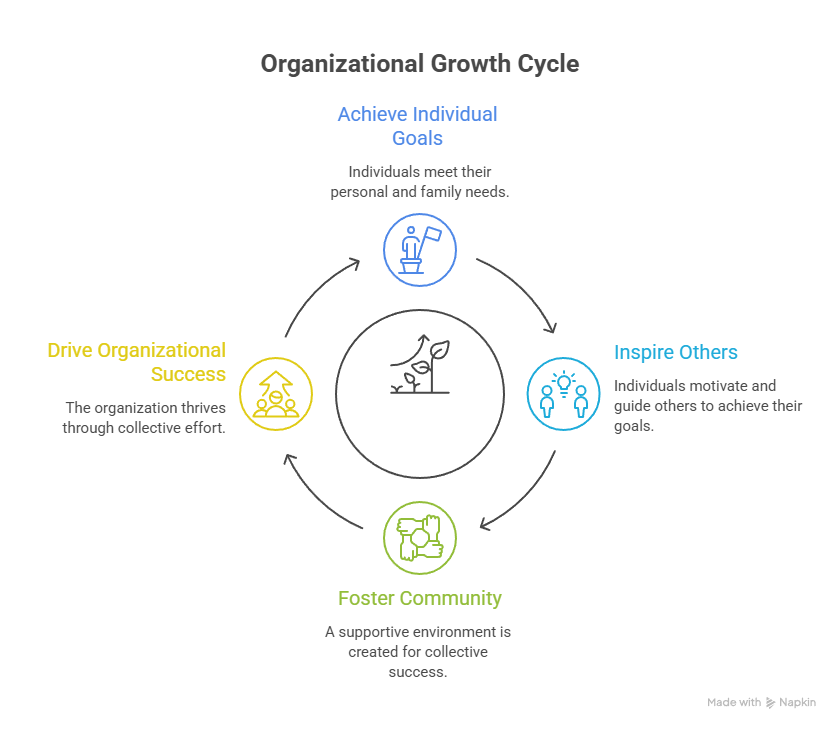
You see the same threshold in other fields. A famous actor eventually faces a choice: live off what has already been earned, or start helping other people become successful too. It is not a coincidence that directors and producers — many of whom started as actors — often have longer, more durable careers than performers who never cross that threshold. The shift from “doing” to “enabling others to do” tends to be the turning point between an individual or organization that keeps expanding and one that quietly starts to decline.
A Practical Checklist: Is Your Organization Ready for a Turnaround Conversation?
Most of these signs are visible well before they show up in quarterly numbers. If several of these feel familiar, it is a strong signal that the team alignment work above is overdue rather than optional:
- More energy in the building goes toward internal politics than toward customers.
- Few people outside the executive team can state the company’s mission in a single sentence.
- Key performance metrics have trended down for two or more consecutive quarters.
- Important conversations happen more often in side chats and hallways than through official channels.
- Long-tenured employees are quietly disengaged, or quietly job-hunting.
- Decisions increasingly get made to protect a department or an individual rather than to advance the mission.
Frequently Asked Questions
What is an organizational turnaround strategy? It is a deliberate process of rebuilding shared purpose and team alignment inside a struggling organization — typically starting with honest conversations about what the company is actually for, followed by re-anchoring procedures, roles, and goals to that clarified purpose rather than to individual agendas.
What are the first signs a company needs a turnaround? Internal conflict, gossip, and scapegoating almost always appear before financial metrics decline. Watch for energy shifting from customers to internal politics — that shift is usually the earliest reliable warning sign.
How do you rebuild company culture after internal conflict? Start with a direct, group-level conversation about purpose rather than a new policy document. Clarify the mission in writing, have honest conversations about who is genuinely aligned with it, and rebuild standard operating procedures around that purpose rather than around old habits.
Does a business have to keep growing to survive? Not in the narrow sense of revenue every quarter. What it cannot do is stand still in purpose — an organization that stops taking on more responsibility or helping more people tends to decline even if its revenue temporarily holds steady.
The Bottom Line
An organization rarely fails because of one bad decision. It fails because individuals, one at a time, quietly stop taking responsibility for the whole and start protecting only themselves — and nobody interrupts that drift before it compounds. The organizational turnaround strategy that actually works is less about a new tactic and more about a direct return to first questions: What are we doing here? Are we making a difference? And what is the next goal big enough for everyone to rally around together?
I have walked companies through exactly this process, starting with those same three questions. If your organization is showing the early signs above, that conversation is worth having before the numbers force it.
Contact us at 813-906-0477: Ask for Vida or Vic.