
A successful life philosophy often begins with a simple idea: take responsibility for what you can control.
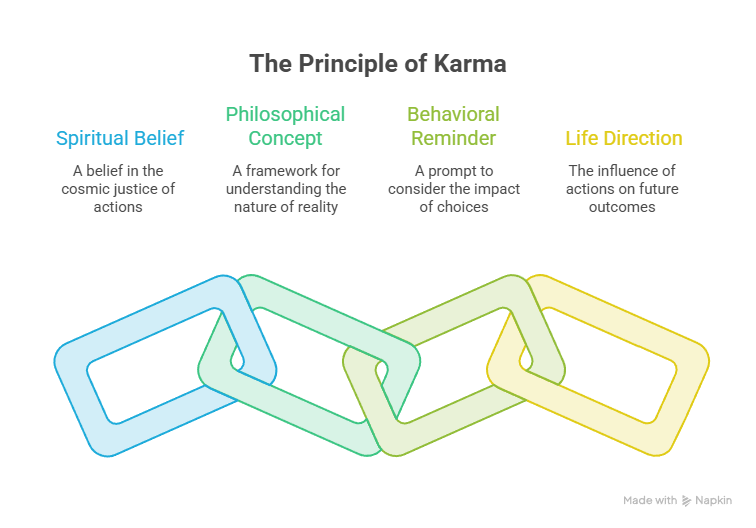
Karma is commonly understood as the principle that actions have consequences. Whether someone approaches karma as a spiritual belief, a philosophical concept, or simply a reminder that behavior produces consequences, the practical lesson can be valuable: the choices we make influence the direction of our lives.
This perspective encourages personal responsibility rather than constant blame. When something goes wrong, instead of asking only, “Who is responsible for this?”, we can also ask:
“What can I learn from this, and what can I do differently going forward?”
That question can transform setbacks into opportunities for learning, improvement, and growth.
In business, relationships, leadership, and personal development, this mindset helps people move from reaction to action.
The Power of Personal Responsibility
Personal responsibility doesn’t mean believing that every event in life is entirely your fault.
Unexpected events happen. Other people make their own choices. Markets change. Accidents occur. Economic conditions can shift, and circumstances outside our control can affect our lives.
Personal responsibility means focusing on your response, your decisions, and your next action.
You may not control everything that happens to you, but you can often control:
- How you respond
- What you learn
- What decisions you make next
- How you communicate
- What boundaries you establish
- Whether you repeat the same mistake
- How you prepare for future challenges
This distinction makes responsibility empowering rather than destructive.
The Illusion of Blame
When something painful happens, the natural response can be to look outward.
A business owner might say:
- “The client caused the problem.”
- “My employees aren’t loyal.”
- “The competition ruined the opportunity.”
- “The market is impossible.”
- “Nobody wants to work anymore.”
Sometimes other people genuinely contribute to a problem. Recognizing that is important.
However, focusing exclusively on external blame can prevent us from identifying the factors we can change.
A more productive question is:
“What part of this situation was within my control?”
The company may need a better hiring process. Expectations weren’t communicated clearly. Perhaps the financial risks weren’t evaluated carefully enough.
Finding your contribution doesn’t mean excusing someone else’s behavior. It means finding the part of the situation that you can actually improve.
Turning Setbacks Into Lessons
A setback becomes more valuable when you learn something from it.
Suppose a business loses an important client.
There are several possible reactions.
The first is frustration:
“The client was unreasonable.”
The second is investigation:
Why did we lose the client?
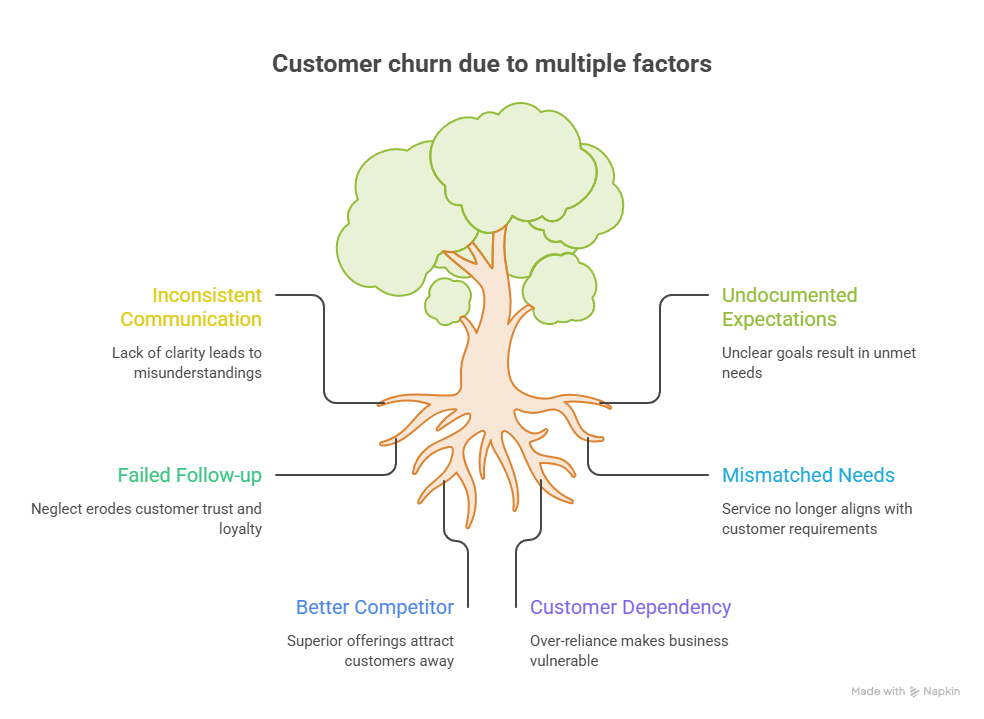
You might discover that:
- Communication was inconsistent.
- Expectations weren’t clearly documented.
- The company failed to follow up.
- The service no longer matched the customer’s needs.
- A competitor offered a better solution.
- The business depended too heavily on one customer.
The second approach creates information.
That information can then become a better process.
This is one of the most practical applications of a success philosophy: turn experience into knowledge and knowledge into better action.
Taking Responsibility Without Taking Unfair Blame
Personal responsibility should never become an excuse for blaming yourself for things you could not reasonably control.
There is an important difference between responsibility and blame.
Blame asks:
“Whose fault is this?”
Responsibility asks:
“What can I do now?”
For example, if a business partner behaves dishonestly, you are not responsible for their decision to act dishonestly.
However, you may be able to examine whether you:
- Had appropriate financial controls
- Clearly defined responsibilities
- Reviewed financial records
- Established appropriate agreements
- Ignored warning signs
- Had sufficient oversight
The purpose isn’t to punish yourself.
The purpose is to strengthen the business so the same vulnerability is less likely to occur again.
Applying Personal Responsibility to Business
A strong culture of personal responsibility can improve almost every area of a business.
Leadership
Leaders set the standard.
When leaders accept accountability for decisions, employees are more likely to take responsibility for their own work.
Employee Management
When performance problems occur, examine both the employee’s actions and the management system.
Were expectations clear?
Was training provided?
Was feedback timely?
Were performance standards measurable?
Financial Management
Financial setbacks should trigger analysis, not panic.
Review:
- Cash flow
- Expenses
- Pricing
- Debt
- Investment decisions
- Customer concentration
- Financial controls
The goal is to identify what can be improved.
Customer Relationships
When a customer complains, don’t automatically assume either side is entirely right or wrong.
Listen carefully.
Determine what happened.
Identify the gap between expectations and delivery.
Then improve the process.
The Myth of “Getting Away With It”
The idea of karma can also encourage people to think about the long-term consequences of their behavior.
A person may appear to benefit from dishonesty in the short term. A business might make money by taking advantage of customers. A manager might achieve results through unethical behavior.
But short-term gains can create long-term costs.
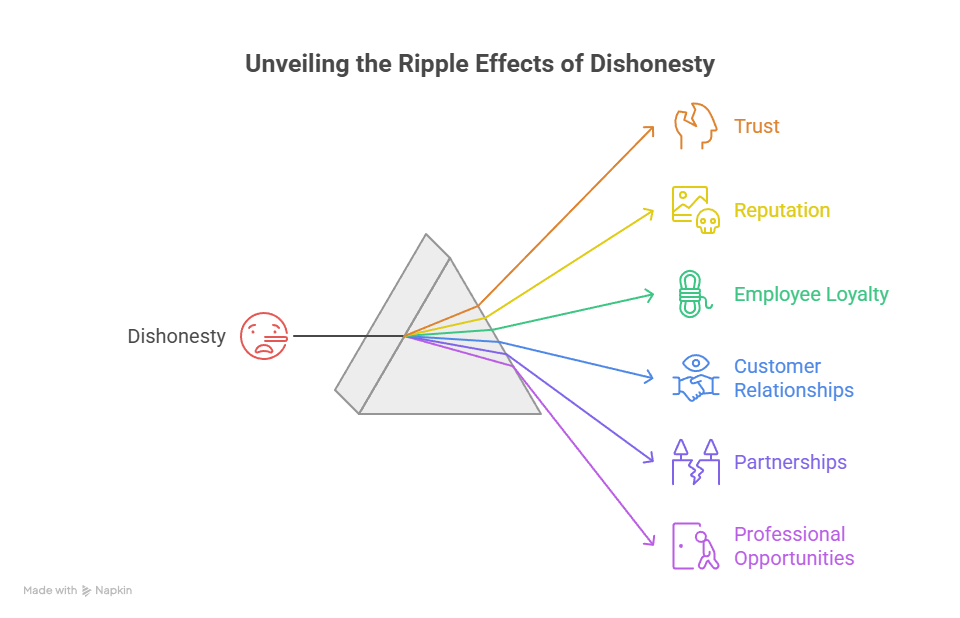
Dishonest behavior can eventually damage:
- Trust
- Reputation
- Employee loyalty
- Customer relationships
- Partnerships
- Professional opportunities
Ethical behavior works differently.
When people consistently communicate honestly, honor commitments, treat employees fairly, and deliver genuine value, they build something that can compound over time: trust.
Trust is one of the most valuable assets a business or individual can develop.
Positive Actions Create Positive Momentum
Whether or not you believe in karma as a literal force, the practical effects of positive behavior are easy to recognize.
Consider a business owner who:
- Pays suppliers on time
- Treats employees with respect
- Keeps commitments
- Helps customers solve real problems
- Develops employees
- Communicates honestly
- Builds strong partnerships
Over time, these actions can create a positive reputation.
That reputation can lead to referrals, stronger relationships, repeat business, better partnerships, and new opportunities.
This doesn’t mean that good people never experience setbacks.
They do.
The lesson is that ethical behavior builds a foundation that can help an individual or organization recover when difficulties occur.
Building Your Personal Accountability Ledger
One practical exercise is to create your own “accountability ledger.”
This doesn’t require believing that a past action causes every event. Instead, use the exercise to identify patterns in your decisions and behavior.
Create two columns:
What Worked
Write down decisions and behaviors that produced positive outcomes.
Examples:
- Keeping commitments
- Treating customers fairly
- Investing in employee development
- Planning ahead
- Communicating clearly
What Needs Improvement
Identify mistakes, missed opportunities, and recurring patterns.
Examples:
- Delaying difficult conversations
- Overspending
- Poor delegation
- Ignoring customer feedback
- Hiring without sufficient evaluation
- Failing to document processes
Then ask:
“What will I do differently next time?”
This converts reflection into action.
Responsibility Creates Freedom
One of the most powerful benefits of personal responsibility is that it gives you something to work with.
If every problem is someone else’s fault, there may be nothing you can change.
But when you identify your own choices, assumptions, systems, or responses, you create an opportunity to improve.
You can change:
- Your habits
- Your decisions
- Your systems
- Your communication
- Your leadership
- Your preparation
- Your response to setbacks
That is where responsibility becomes empowering.
A Practical Success Philosophy
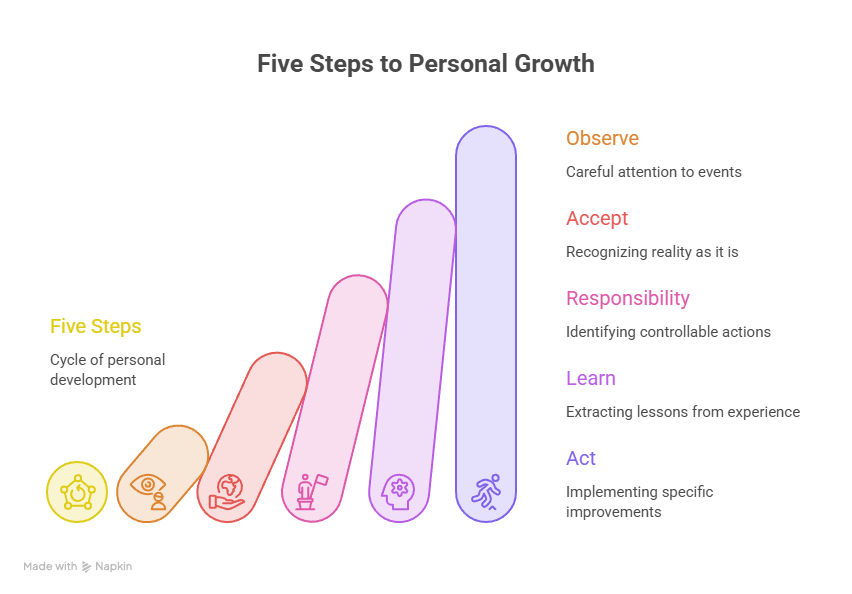
A useful success philosophy can be built around five principles:
1. Observe
Look carefully at what is happening before reacting.
2. Accept Reality
Recognize the situation as it is rather than as you wish it were.
3. Take Responsibility
Identify what is within your control.
4. Learn
Determine what the experience can teach you.
5. Act
Make a specific change that improves your future results.
This creates a continuous cycle:
Experience → Reflection → Learning → Action → Improvement
Over time, this cycle can produce significant personal and professional growth.
Personal Responsibility and Long-Term Success
Success isn’t simply about avoiding failure.
It is about developing the ability to learn from experience and continually improve.
A person who accepts responsibility can examine mistakes without becoming trapped by them.
A business owner can lose a customer and improve the sales process.
A leader can make a poor hiring decision and improve recruitment.
An entrepreneur can make a bad investment and strengthen financial analysis.
A manager can mishandle a conflict and develop better communication skills.
The setback becomes useful because it produces knowledge.
Final Thoughts
A successful philosophy doesn’t require us to believe that every event is predetermined or that we personally caused every hardship.
A more practical lesson is this:
Focus on what you can control, learn from what happens, and take responsibility for what you do next.
Karma can be viewed as a reminder that actions have consequences. In everyday life, ethical behavior, accountability, and thoughtful decision-making can create positive momentum, while repeated poor decisions can create patterns that eventually become difficult to overcome.
The most useful question after a setback isn’t simply:
“Who did this to me?”
It is:
“What can I learn, what can I control, and what will I do differently from this point forward?”
That mindset transforms responsibility from a burden into a source of strength.
When you consistently learn from experience, act with integrity, and focus on creating better outcomes for yourself and others, you build a foundation for lasting success.
Frequently Asked Questions About Personal Responsibility and Success
What is personal responsibility?
Personal responsibility is the practice of recognizing your role in your decisions, actions, and responses. It means focusing on what you can control and taking constructive action rather than relying entirely on blame or external circumstances.
How does personal responsibility contribute to success?
Personal responsibility encourages people to learn from mistakes, make better decisions, improve their habits, and take action when problems arise. These behaviors can support stronger performance in business, careers, relationships, and personal development.
Does personal responsibility mean everything that happens is your fault?
No. Taking responsibility does not mean accepting blame for events outside your control. Other people, circumstances, accidents, and external conditions can affect your life. Responsibility means identifying what you can control and deciding how to respond.
What is the connection between karma and personal responsibility?
Karma is interpreted differently across religious and philosophical traditions. In a practical sense, the concept can be viewed as a reminder that actions have consequences. Personal responsibility applies this idea by encouraging people to examine their choices and consider the effects of their behavior.
How can I stop blaming others for my problems?
Start by separating what you can control from what you cannot. Ask questions such as: “What could I have done differently?”, “What can I change now?”, and “What can I learn from this experience?” This approach shifts attention from blame toward constructive action.
How can personal responsibility help business owners?
Business owners can use personal responsibility to examine hiring decisions, financial choices, customer relationships, leadership practices, and business systems. Instead of simply blaming employees, customers, or competitors, they can identify weaknesses they can improve.
How can I learn from a business failure?
Analyze the failure objectively. Identify what happened, what decisions contributed to the outcome, what warning signs were missed, and what systems could prevent the same problem in the future. Turn the experience into a documented lesson and an action plan.
Does positive behavior guarantee success?
No. Ethical behavior and positive actions cannot guarantee that someone will always succeed or avoid hardship. Integrity, reliability, and thoughtful decision-making can create lasting trust, stronger relationships, and a respected reputation.
What is an accountability ledger?
An accountability ledger is a reflection exercise used to review decisions and outcomes. You can record what worked, what went wrong, what you learned, and what you will change. It is a practical tool for turning experience into continuous improvement.
What is the most important principle of a successful philosophy?
One of the most practical principles is to focus on what you can control. Learn from experience, accept responsibility for your decisions, act with integrity, and continually improve your approach. This creates a mindset focused on growth rather than helplessness.
We hope you found this article helpful! If it brought up questions about your own business, you don’t have to figure everything out on your own.
We’d be happy to sit down with you for a free Business Analysis and Consultation to discuss your goals, challenges, and opportunities and help you determine your next best steps.
To get started, contact Vida Puodziunas at 813-906-0477.