

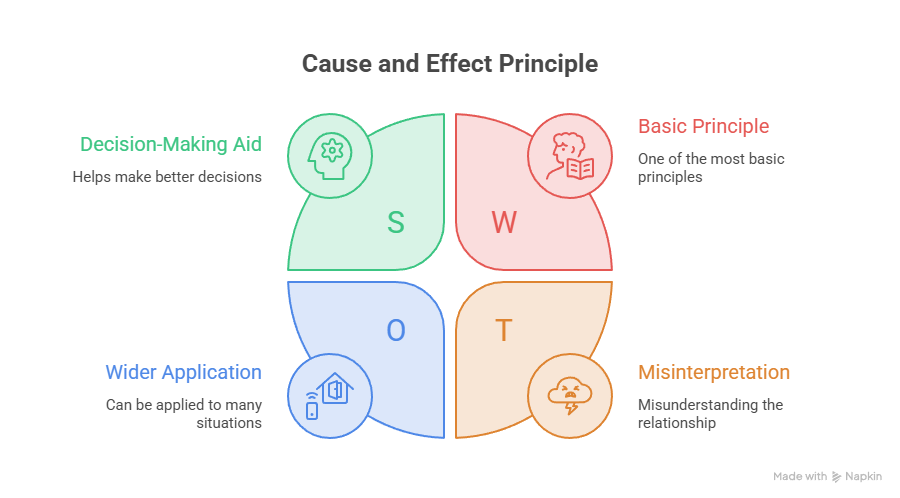
Cause and effect is one of the most basic principles we learn in school. Every action produces a consequence, and understanding that relationship can help us make better decisions.
In business, however, cause and effect can become more complicated.
Many business owners want the effects of success without always being willing to accept the uncertainty, responsibility, and risk that come with taking action.
They want business growth, but they fear making the decisions required to achieve it.
They want more employees, but they don’t want the management challenges that come with expansion.
They want higher revenue, but they hesitate to invest in marketing, training, technology, or new opportunities.
This creates an important leadership lesson:
You cannot consistently create new effects without being willing to create new causes.
Growth requires action, and action always involves consequences.
Understanding Cause and Effect in Business
Cause refers to an action, decision, or condition that contributes to an outcome.
Effect is the resulting consequence.
For example:
Cause: A company implements a structured employee training program.
Effect: Employees understand their responsibilities better, make better decisions, and require less day-to-day supervision.
Another example:
Cause: A business owner invests in a new marketing strategy.
Effect: The company may generate more leads and customers—but it may also need additional staff, systems, and resources to handle the increased demand.
This is why business decisions should be evaluated as connected systems rather than isolated events.
Before making an important decision, ask:
- What outcome am I trying to create?
- What action will produce that outcome?
- What additional effects could this action create?
- What risks could appear?
- What resources will be required?
- Am I prepared to handle the consequences?
This type of thinking improves strategic decision-making.
Why Business Owners Sometimes Fear Expansion
Expansion sounds exciting, but growth creates new responsibilities.
A business owner may hesitate to expand because they are afraid of:
- Losing money
- Hiring the wrong people
- Taking on debt
- Managing more employees
- Losing control
- Making a bad investment
- Increasing operating costs
- Failing in a larger market
The fear isn’t necessarily irrational.
Expansion does involve risk.
The problem occurs when fear prevents the owner from taking any meaningful action.
The most successful entrepreneurs are not necessarily people who never experience fear or failure.
They are often people who understand that failure is one possible effect of taking action, and they are willing to learn from it.
Risk, Failure, and Business Growth
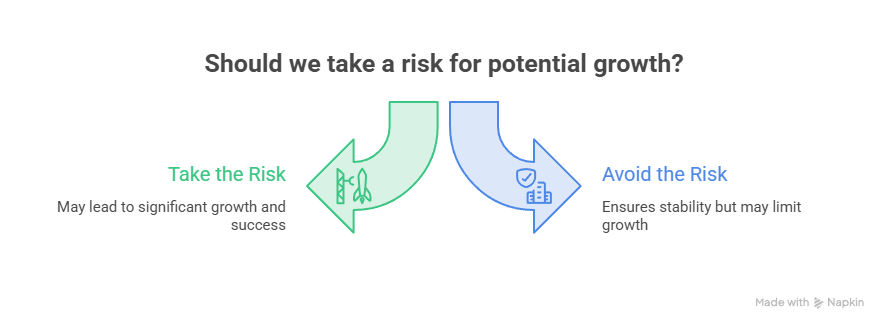
Every meaningful business decision carries some degree of uncertainty.
You can launch a product that fails.
You can hire someone who doesn’t work out.
You can enter a new market that doesn’t perform as expected.
You can invest in technology that doesn’t produce the anticipated return.
That doesn’t mean you should take reckless risks.
It means you should understand the difference between calculated risk and avoidance.
Calculated risk involves:
- Defining the desired outcome
- Evaluating available information
- Estimating potential costs
- Identifying possible problems
- Creating safeguards
- Making the decision
- Measuring the results
- Adjusting the strategy
This creates a healthier relationship with uncertainty.
Winning Every Battle Is Not the Same as Winning
Business disputes can reveal another aspect of cause and effect: the desire to control every outcome.
When two parties are determined to get everything their way, negotiations can become unnecessarily difficult.
Each person may believe that accepting the other person’s proposal means losing.
But effective negotiation requires flexibility.
Sometimes the best decision is to accept a short-term loss to prevent a much larger long-term problem.
This is the principle behind:
“Lose the battle to win the war.”
For example, a business dispute could cost $20,000 to resolve through prolonged litigation.
A settlement of $8,000 might initially feel like a loss.
But if the settlement:
- Ends the conflict
- Protects the business relationship
- Saves legal expenses
- Frees management time
- Allows both parties to move forward
then accepting the settlement may create a better overall outcome.
The objective isn’t always to prove that you are right.
Sometimes the objective is to create the best future result.
The Importance of Give and Take
Healthy relationships require a balance between leading and following, giving and receiving, speaking and listening.
This applies to:
- Business partnerships
- Marriage
- Friendships
- Leadership
- Customer relationships
- Employee relationships
A person who must always be in control can create unnecessary conflict.
Effective leaders know when to take responsibility and when to let someone else lead.
They know when to give direction and when to listen.
They know when to make a decision and when to accept another person’s expertise.
This flexibility creates stronger relationships and better organizations.
Cause and Effect in Leadership
Leadership is not about making every decision yourself.
A strong leader creates an environment where other people can make good decisions.
If employees must constantly ask:
“What should I do?”
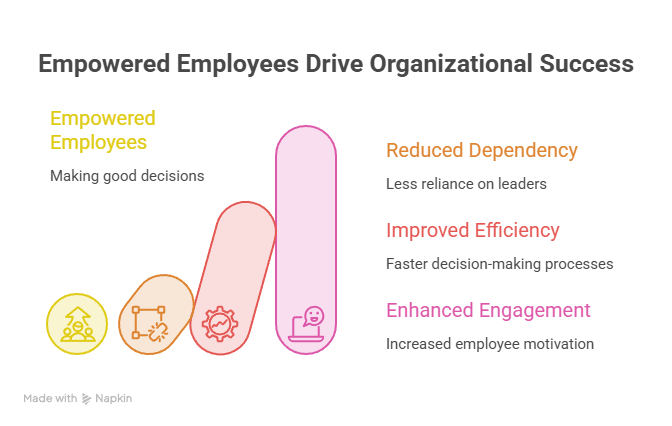
the organization becomes dependent on the owner or manager.
The leader remains the primary source of direction, while employees become dependent on instructions.
That isn’t scalable.
A stronger approach is to develop employees who understand:
- What the company is trying to accomplish
- What their responsibilities are
- What standards they are expected to meet
- How to solve common problems
- When they can make decisions independently
- When they need to escalate an issue
This is where staff training becomes essential.
Staff Training Creates Better Decision-Makers
Employee training shouldn’t be treated as punishment or an inconvenience.
A well-designed staff training system gives employees the knowledge and confidence to make better decisions.
Training can include:
- Job-specific procedures
- Customer service
- Communication
- Leadership
- Safety
- Technology
- Problem-solving
- Company policies
- Product knowledge
- Decision-making
The objective is not simply to tell employees what to do.
The objective is to help them understand why they are doing it and how to respond when circumstances change.
Why Employees May Resist Training
Employees don’t always resist training because they are lazy or unwilling to learn.
Sometimes resistance occurs because training can feel like criticism.
An employee may interpret:
“You need additional training.”
as:
“You aren’t good enough.”
How training is presented matters.
Instead of presenting training as a correction, position it as professional development.
Explain how the training can help employees:
- Become more capable
- Take on greater responsibility.
- Earn promotions
- Make better decisions
- Reduce mistakes
- Improve confidence
- Build valuable skills
When employees understand the personal benefit, training can become an opportunity rather than an obligation.
Build a Staff Training System
A scalable business should not rely entirely on experienced employees teaching new employees informally.
Create a repeatable training system.
A simple system can include:
Step 1: Document the Process
Write down how important tasks should be completed.
Step 2: Add Visual Resources
Use screenshots, diagrams, photos, videos, and examples where appropriate.
Step 3: Demonstrate
Show employees what good performance looks like.
Step 4: Practice
Allow employees to apply what they learned.
Step 5: Evaluate
Test understanding through practical exercises or assessments.
Step 6: Provide Feedback
Identify what was done well and what needs improvement.
Step 7: Certify Competency
Confirm that the employee can perform the responsibility independently.
This creates a stronger foundation for business growth.
Give Employees the Ability to Make Decisions
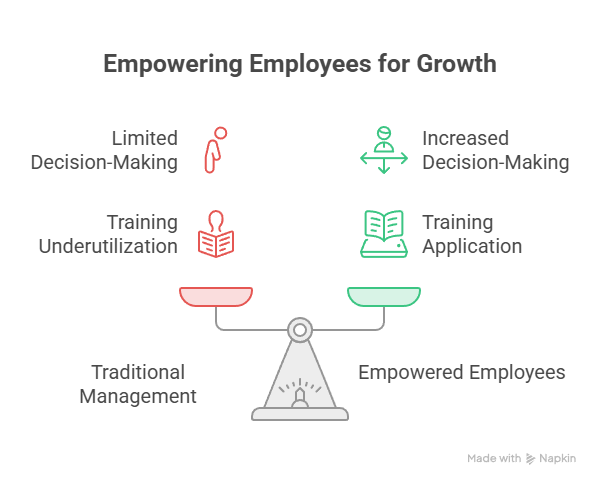
Training becomes far more valuable when employees have opportunities to use what they learned.
For example, instead of telling an employee:
“Always ask me before giving a customer a refund.”
you might establish a clear policy:
“You can authorize refunds up to $100 when the customer meets these conditions.”
Now the employee has both:
Training + Authority
That combination creates stronger decision-makers.
It also reduces the number of routine decisions that must reach management.
The Connection Between Training and Business Expansion
As a business grows, the owner cannot personally handle every decision.
If every decision requires the owner’s approval, expansion eventually becomes limited by the owner’s time.
This creates a bottleneck.
Effective staff training helps remove that bottleneck.
Well-trained employees can:
- Solve routine problems
- Handle customers
- Manage processes
- Train new employees
- Identify issues
- Make decisions
- Lead departments
The business becomes less dependent on one person.
That is one foundation of sustainable expansion.
Accepting Help Is Also Part of Leadership
Some people have difficulty acknowledging when someone else helped them.
They may feel that accepting advice makes them less capable.
But effective leaders don’t need to know everything.
A strong leader can say:
“That’s a good idea. I hadn’t considered that.”
Acknowledging useful advice doesn’t diminish your authority.
It demonstrates confidence.
The strongest organizations are built by people who combine their knowledge rather than competing to prove who knows the most.
Balance Responsibility With Collaboration
A healthy business requires both individual accountability and collaboration.
Employees should take responsibility for their work.
Managers should take responsibility for their teams.
Executives should take responsibility for organizational results.
At the same time, everyone should be willing to:
- Ask for help
- Receive feedback
- Share information
- Accept useful advice
- Delegate
- Collaborate
- Learn from mistakes
This balance creates an organization where people can both lead and contribute.
Cause and Effect: A Practical Business Framework
Before making a significant business decision, use this five-step framework.
1. Identify the Cause
What action are you considering?
2. Define the Desired Effect
What result do you want?
3. Identify Secondary Effects
What else could happen as a result?
4. Prepare the Organization
Do you have the people, systems, training, and resources required?
5. Measure and Adjust
After taking action, evaluate what actually happened.
This turns cause-and-effect thinking into a practical management tool.
The Relationship Between Cause, Effect, and Expansion
Business expansion is ultimately a chain of causes and effects.
For example:
Better Training → Better Employees → Better Decisions → Better Customer Experience → Higher Retention → More Revenue → More Resources for Growth
Every stage affects the next.
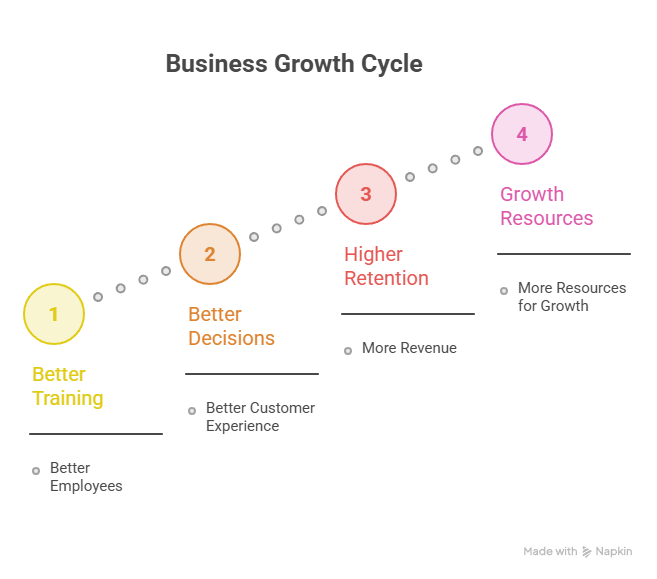
If you skip a critical stage, the expansion process can become unstable.
For example, increasing marketing without improving operations may produce more customers than the business can effectively serve.
The result could be:
More Leads → More Customers → Poor Service → Complaints → Lost Customers
The lesson is clear:
Don’t create an effect without preparing for the effects that follow it.
Final Thoughts
Understanding cause and effect in business can help owners and leaders make better decisions.
Growth requires action.
Action creates consequences.
Some consequences will be positive, while others may involve mistakes, setbacks, or unexpected challenges.
The goal isn’t to eliminate every possible negative outcome.
The goal is to understand the relationship between your decisions and their consequences well enough to make better choices.
Build strong staff training systems.
Give employees the ability to make appropriate decisions.
Be willing to lead and be willing to follow.
Accept useful advice.
Don’t fear every possible negative outcome.
And when pursuing business growth, remember that expansion requires you to create new causes before you can experience new effects.
Be willing to take action, learn from the results, and continually improve the system that produces them.
Frequently Asked Questions About Cause and Effect in Business
What does cause and effect mean in business?
Cause and effect describes the relationship between business actions and their resulting outcomes. A decision, investment, process, or behavior can create consequences that influence customers, employees, finances, and growth.
How does cause and effect influence business growth?
Business growth depends on creating actions that produce desirable results. For example, effective marketing can increase leads, while staff training can improve employee performance. Understanding these relationships helps businesses make better strategic decisions.
Why are some business owners afraid to expand?
Expansion creates uncertainty and risk. Owners may fear financial losses, hiring problems, increased expenses, or losing control. Understanding and managing these risks can make expansion more deliberate and sustainable.
Is taking business risks necessary for growth?
Meaningful growth generally involves some degree of risk because future outcomes cannot be guaranteed. The objective should be calculated risk-taking based on research, planning, financial analysis, and appropriate safeguards—not reckless decisions.
Why is staff training important?
Staff training helps employees develop the knowledge and skills necessary to perform their responsibilities effectively. Good training can improve decision-making, consistency, productivity, customer service, and employee development.
How can training help a business expand?
Training creates employees who can perform responsibilities independently. As more employees can make good decisions without constant supervision, the business becomes less dependent on the owner and can scale more effectively.
How can I reduce employee resistance to training?
Explain the benefits of training clearly. Show employees how new skills can improve their performance, confidence, career opportunities, and ability to take on greater responsibility. Make training practical, engaging, and relevant to their work.
Should employees be allowed to make their own decisions?
Yes, within clearly defined boundaries. Employees should understand which decisions they can make independently and which situations require management approval. Training and clear policies provide the foundation for responsible autonomy.
Does accepting someone else’s advice make a leader less authoritative?
No. Being willing to receive useful advice demonstrates confidence and openness to learning. Strong leaders understand that they don’t need to have every answer themselves.
What is the best way to handle a business disagreement?
Focus on the desired long-term outcome rather than simply trying to win the argument. Listen to the other party, identify common interests, evaluate the costs of continued conflict, and consider solutions that allow both parties to move forward.
How can cause-and-effect thinking improve leadership?
It encourages leaders to consider the consequences of their decisions before acting. Leaders can evaluate how a decision may affect employees, customers, finances, operations, and future growth rather than focusing only on the immediate result.
What is the key lesson about cause and effect?
Every meaningful action can produce consequences. Effective business leaders learn to anticipate those consequences, accept reasonable risks, learn from results, and continually improve the actions and systems that create business outcomes.
Every business is different, and what works for one may not fit another. If you’d like to talk through your situation, call Vida Puodziunas at 813-906-0477. Ask about our free business analysis, a no-cost look at where your business stands today and what growth could look like from here.