

If you trace almost any success story or failure in business back to its root cause, you will usually land on the same place: communication. The way information moves — or fails to move — between leadership, staff, and customers shapes everything from daily productivity to long-term company growth. Strong business communication skills are often the single biggest differentiator between organizations that scale smoothly and those that stall under their own weight.
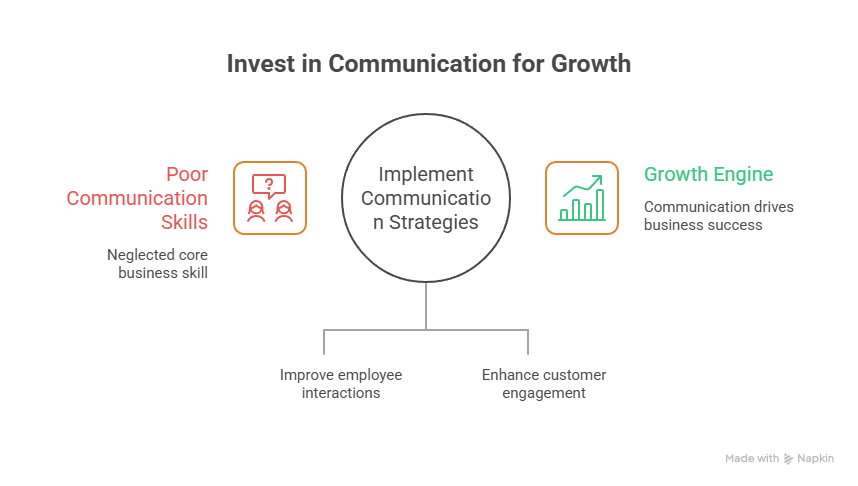
Despite this, communication is rarely treated as a core business skill worth investing in. Companies pour far more energy into sales targets, product development, or marketing campaigns than into how well their people actually talk to each other and to their customers. This article covers why that is a costly mistake, the warning signs of a communication breakdown, and the specific internal communication strategies that turn this overlooked skill into a genuine growth engine.
What Are Business Communication Skills, and Why Do They Matter So Much?
Business communication is not limited to emails and meetings. It includes everything written, verbal, and visual that a company puts into the world: how the phone is answered, how a contract is worded, how a product is packaged, even how an employee dresses for a client meeting. Every one of these moments either builds trust or quietly chips away at it.
This is why business communication skills function less like a soft skill and more like infrastructure. When that infrastructure is solid, decisions move quickly, customers feel informed, and staff understand what is expected of them. When it is weak, the same problems resurface again and again: missed deadlines, frustrated customers, duplicated work, and employees who quietly disengage because nobody bothered to tell them what mattered.
The financial stakes are bigger than most leaders assume. A widely cited 2025 industry survey of U.S. business leaders and knowledge workers put the annual cost of poor workplace communication at roughly $1.2 trillion, driven by lost productivity, higher turnover, and customer churn — with leaders estimating their teams lose nearly a full workday every week to unclear communication alone. That is not an abstract statistic. It shows up as canceled contracts, repeated rework, and good employees who eventually walk out the door.
Auditing Your Company’s Effective Workplace Communication
Before you can fix a communication problem, you need to see it. Sitting in a company’s reception area for an hour, or simply reading its recent reviews, tells you almost everything you need to know. Here is a quick self-audit, split into what your customers experience and what your own team experiences.
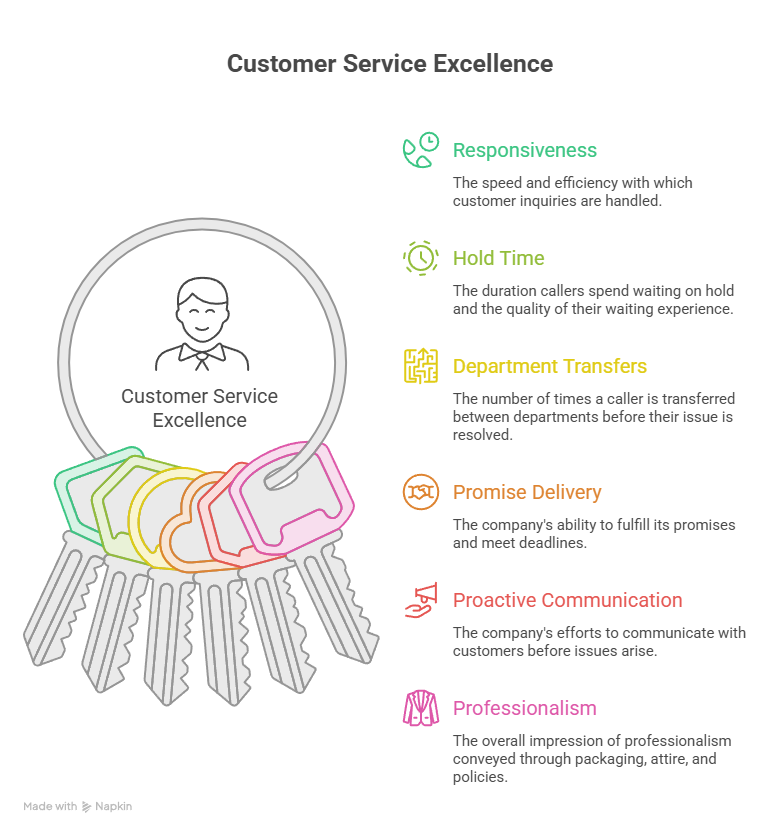
What customers and prospects experience:
- How many rings before the phone is answered, and how is it answered?
- How long are callers put on hold, and what do they hear while waiting?
- How many departments does a caller get bounced through before their issue is handled?
- Does the company deliver what it promises, within the timeframe it promised?
- Does the business communicate with customers proactively, not just when something goes wrong?
- Do packaging, attire, and written policies communicate professionalism and confidence, or do they undercut it?
What your team experiences internally:
- Does staff know management’s short- and long-term strategic goals, or only their own task list?
- Is there a reliable internal communication system telling people what is expected of them and how they are doing?
- Do staff in one part of the business know what staff in other parts are doing?
- Is there a real quality-control loop that catches and reduces customer complaints before they repeat?
- What does staff morale actually look like, beneath the surface?
If you answered “not sure” to more than a couple of these, you have just identified your fastest, lowest-cost opportunity for improvement.
How Weak Internal Communication Strategies Quietly Stall Growth
The growing pains of a small business almost always trace back to its communication systems. Many companies lack workable software for accurate reporting and data collection — a basic project tracker, a shared customer record, a simple way to see what is actually happening across departments. That gap alone is enough to cap how large a business can grow before it starts breaking under its own complexity.
You can predict whether a business is expanding or contracting just by reading its online reviews. Yelp, Google, and Glassdoor are, in effect, a public scoreboard for internal communication. A one-star review complaining about being transferred five times is rarely about the product — it is a complaint about ownership and routing inside the company, dressed up as a customer service problem.
In my work resolving business disputes, I see this pattern constantly. Most disputes end in a financial settlement, but almost all of them begin months earlier as a communication failure: an assumption that was never checked, a complaint that was never escalated, an expectation that was never written down. By the time lawyers are involved, the real cause has long since stopped being about money and started being about a conversation that never happened.
A Cautionary Tale: How One Negative Voice Triggered a Mass Exodus
In one small business I was consulting with, turnover hit roughly ten staff members in under a year. It turned out one key employee — a low producer — had been taking different staff members to lunch and talking negatively about the executives and the company. That person eventually left, and eight or nine others followed within months.
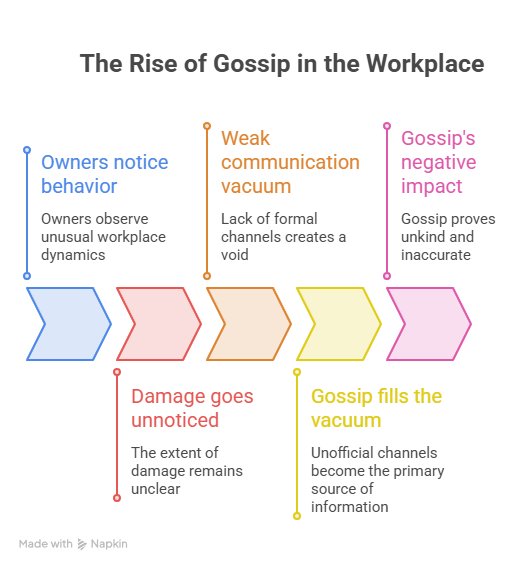
The owners had actually noticed the behavior. What they had not grasped was how much damage it was doing while it was happening, because there was no formal channel competing with it. Gossip fills exactly the vacuum left by weak effective workplace communication: when people do not get information through official channels, they get it through unofficial ones, and unofficial channels are rarely kind or accurate.
The fix I recommend in situations like this is simple and almost always effective: a written policy that no executive or staff member criticizes anyone in the company, including customers and clients, in informal settings. If a staff member needs correction, the right channel is a written report to the appropriate executive, copied to the employee — not a complaint over lunch. It feels almost too basic to work, but it closes the exact gap that gossip exploits.
Communication Breakdowns That Quietly Damage Every Business
Most communication failures fall into a few recognizable categories. Naming them makes them easier to catch before they compound.
Dishonesty and distortion
- Criticizing people to others instead of addressing them directly
- Telling outright lies
- Forwarding exaggerated or incomplete facts
- Acting on a situation without all the relevant data
Avoidance and delay
- Not responding to communications in a timely manner
- Withholding information about a problem to avoid reprimand
- Avoiding a difficult conversation altogether
Structural breakdowns
- Bypassing the chain of command to give orders to another executive’s staff
- Weak marketing or public relations that miscommunicates what the company actually offers
- Underdeveloped sales skills that misread what the customer actually needs
- Causing a problem deliberately in order to advance a personal agenda
Each of these looks like an isolated bad habit, but they share a common thread: someone chose short-term convenience over long-term trust. Left unchecked, they compound — and that compounding is exactly what shows up later as declining morale, rising turnover, and a growth curve that flattens out for no obvious reason.
Building Stronger Business Communication Skills: Practical Strategies for Growth
Knowing where communication breaks down is only half the work. Here are the strategies that actually move the needle, roughly in order of impact:
- Put the no-negative-talk policy in writing, and apply it to leadership too. Policies that only bind frontline staff lose credibility fast.
- Share the strategic plan, not just the schedule. Staff make better day-to-day decisions when they understand short- and long-term goals, not only their immediate task list.
- Invest in basic reporting and data systems before you think you need them. Even a simple shared tracker for projects, customers, or complaints prevents the “growing pains” that come from scaling without visibility.
- Standardize customer-facing moments. A clear phone-answering protocol, a maximum hold time, and consistent delivery timelines do more for customer trust than almost any marketing spend.
- Build quality control into customer service, not just production. Track complaints for patterns, not just individual incidents, and fix the root cause rather than the symptom.
- Make cross-department visibility a habit. A five-minute weekly update or shared dashboard so each team knows what the others are working on prevents duplicated effort and finger-pointing.
- Train managers to receive feedback, not just deliver it. Staff need a real channel to escalate concerns — the same channel that, if missing, gets filled by gossip instead.
Why Effective Workplace Communication Is the Real Engine of Growth
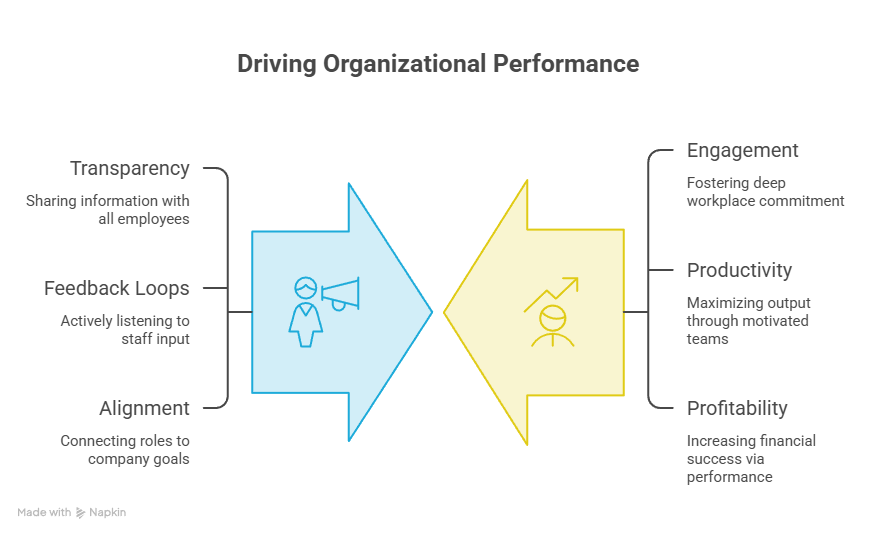
Morale and communication move together, and the relationship is not subtle. Employee-engagement research consistently finds that companies in the top quartile of engagement meaningfully outperform those in the bottom quartile on both profitability and productivity — and engagement itself is, more often than not, a reflection of how well people are kept informed and heard, not a separate initiative bolted on top.
Turnover tells the same story from a different angle. Replacing a single mid-level employee commonly costs tens of thousands of dollars once recruiting, training, and lost momentum are factored in — and a meaningful share of voluntary exits trace back to employees feeling uninformed or unheard rather than underpaid.
Customer-facing growth follows the same pattern. Companies that get communication right do not just retain staff; they retain customers and shorten the sales cycle, because consistent, clear communication is what makes a brand feel trustworthy enough to refer to someone else. Opportunities tend to follow naturally from improving everything a company is already doing, and few improvements compound faster than a steady rise in the professional level of communication across the organization.
Frequently Asked Questions
What are the most important business communication skills for managers? Clear written reporting up and down the chain, timely responses, the ability to deliver hard news without softening it into something unrecognizable, and consistency between what is promised and what is delivered tend to be the highest-leverage skills of all.
How can a small business improve internal communication without expensive software? A written escalation policy, a short weekly team meeting, and a single shared document or calendar for goals will outperform almost any standalone software purchase, especially in the first year.
What does poor communication actually cost a business? Industry research puts the U.S. business-wide cost in the trillions of dollars annually once lost productivity, turnover, and customer churn are combined — and that is before accounting for legal disputes that originate from a breakdown in communication.
Is staff gossip really a communication problem? Yes. Gossip is rarely the root issue; it is a symptom of no formal channel existing for staff to raise concerns. Close that gap and the gossip usually shrinks on its own.
The Bottom Line
Business communication skills are not a department, a training module you run once, or a line item to revisit during budget season. They are the connective tissue running through hiring, customer service, sales, leadership, and every system in between — which is exactly why they are the ultimate foundation for expansion rather than a supporting detail.
If you are ready to put real internal communication strategies in place rather than just talking about communication, we help businesses design and implement the systems that make it stick, from written policy through the software that supports it. Reach out, and we will start by mapping out exactly where communication is breaking down in your business today.
Ready to Take your Business to the Next level?
Very successful business starts with the right strategy, systems, and guidance. If you have questions about this article or would like to discover opportunities to improve your business, we invite you to schedule a Business Analysis and Consultation with our team.
During this consultation, we’ll evaluate your business using our proven 5Ps Framework and identify areas for growth, increased profitability, stronger leadership, and improved operational efficiency.
Whether you’re looking to grow, scale, improve profitability, or gain more freedom as a business owner, we’re here to help.
Contact Vida or Victor today at 813-906-0477 to schedule your Business Analysis and Consultation and learn how SBM Business Centers can help your business reach its full potential.