

Many business owners dream of growing their company, but few realize that sustainable growth depends on one essential leadership skill: executive delegation. The ability to delegate tasks effectively allows business owners and executives to move away from day-to-day operations and focus on strategy, leadership, and expansion.
Unfortunately, many leaders struggle to let go of responsibilities. They become micro-managers, believing no one can perform a task as well as they can. While this mindset may stem from previous bad experiences, it often becomes the greatest obstacle to business growth. Organizations cannot scale if the owner remains responsible for every decision and every task.
True executive leadership is not about doing everything yourself—it is about building systems, developing people, and empowering others to succeed.
Why Delegation Is Essential for Business Growth
Every growing business eventually reaches a point where the owner becomes the bottleneck. When executives continue performing operational tasks instead of leading strategically, business expansion slows down.
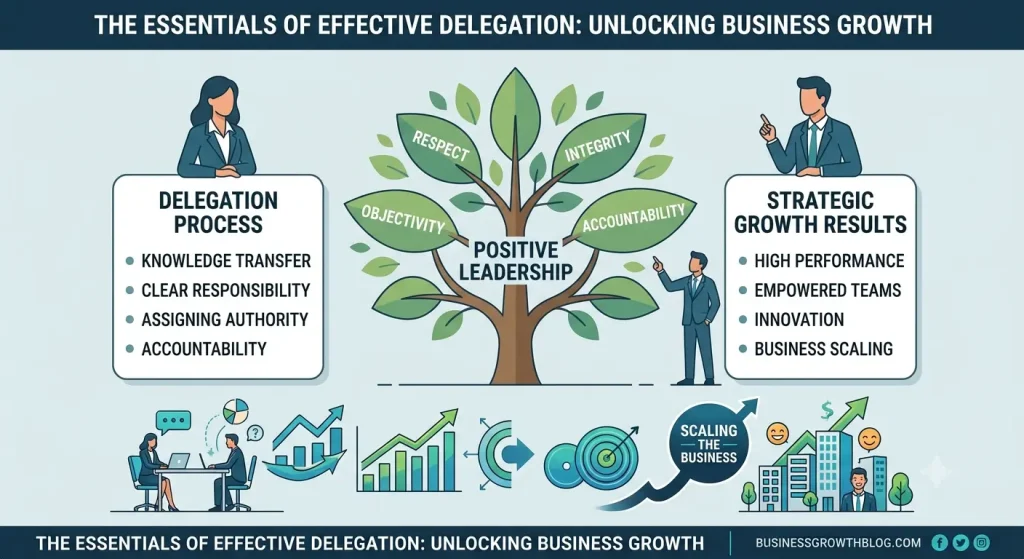
Delegation is not simply assigning work to someone else. It is a structured process of transferring knowledge, responsibility, authority, and accountability so that others can consistently produce the desired results.
Successful delegation creates more time for executives to focus on business development, strategic planning, improving systems, building leadership teams, and increasing profitability.
The more effectively a leader delegates, the greater the organization’s capacity to grow.
Why Many Executives Struggle to Delegate
Many executives become micro-managers because they have experienced disappointment when delegating tasks in the past. Often, the problem is not the employee—it is the lack of documentation, training, and clear expectations.
Simply explaining a task verbally is rarely enough.
Without written procedures, employees are left to interpret instructions differently, leading to inconsistent results.
Effective delegation begins with creating systems that allow someone else to perform the job successfully without constant supervision.
Document Every Position Before Delegating
One of the most valuable habits an executive can develop is documenting every role within the organization.
A complete position description should include:
- The purpose of the position
- Key responsibilities
- Step-by-step operating procedures
- Performance expectations
- Required skills
- Desired attitude and mindset
- Key performance indicators (KPIs)
- Reporting responsibilities
- Quality standards
Most organizations document only the actions required for a job. However, high-performing employees also understand the viewpoint, purpose, and attitude expected of the role.
When employees understand not only what to do but why it matters, they perform with greater ownership and confidence.
Expansion Happens Through Systems
Business expansion follows a predictable pattern.
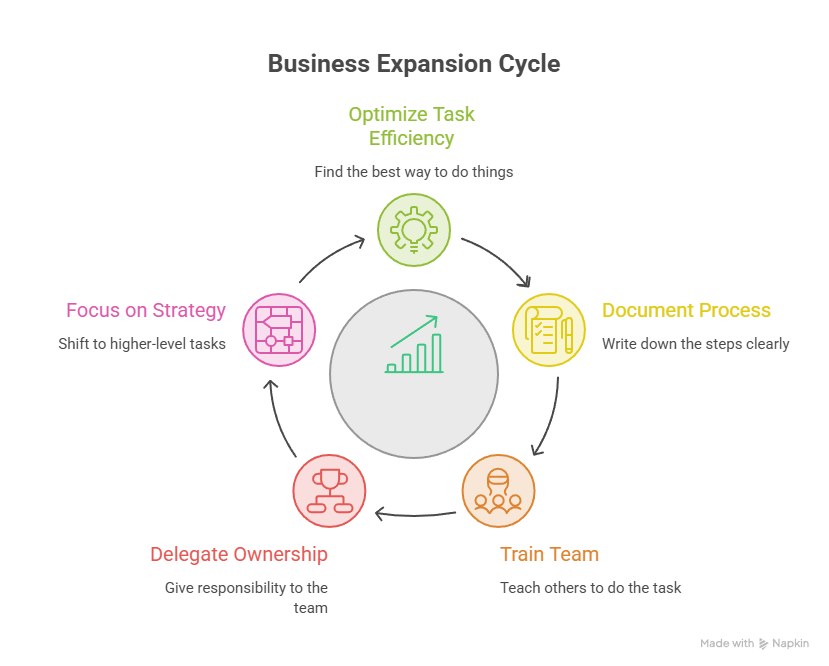
First, figure out the most efficient way to perform a task.
Next, document the entire process.
Then train someone else to perform it consistently.
Finally, allow them to take ownership while you move your attention toward higher-value responsibilities.
Every successful delegation frees the executive to focus on strategic growth instead of operational work.
Over time, this process creates a business that operates through systems rather than depending on one individual.
The Six-Step Executive Delegation Process
1. Document the Position
Write detailed procedures covering responsibilities, workflows, expected outcomes, and the mindset required for success.
Clear documentation creates consistency and reduces confusion.
2. Select the Right Person
Choose someone who genuinely wants the responsibility and demonstrates the willingness to learn, improve, and contribute to the organization’s success.
Skills can often be taught.
Attitude and commitment are far more difficult to develop.
3. Provide Structured Training
Use an apprenticeship approach by working alongside the employee until they understand both the technical and strategic aspects of the role.
Training should include observation, coaching, feedback, and practical experience.
The apprenticeship is complete when the employee begins identifying improvements and solving problems independently.
4. Define Success with Measurable Metrics
Every position should have a clearly defined production formula or key performance indicators (KPIs).
For example, a healthcare practice may measure:
- New patients
- Consultations completed
- Treatment acceptance rate
- Patient visits
- Clinical documentation
- Billing accuracy
- Patient referrals
- Patient retention
- Online reviews
- Practice growth
Clear metrics remove uncertainty and allow employees to understand exactly what success looks like.
5. Invest in Ongoing Training
Delegation is not a one-time event.
Continuous learning helps employees improve their knowledge, confidence, and performance.
Organizations that prioritize professional development build stronger leaders and create more opportunities for business expansion.
6. Build Confidence Until They Surpass You
The ultimate goal of executive delegation is not to create employees who merely maintain standards—it is to develop leaders who perform even better than you did.
Great executives celebrate when team members outperform them because it allows the organization to continue growing.
Purpose Drives Better Performance
Two employees may perform identical tasks, yet achieve dramatically different results.
Why?
The difference often lies in purpose.
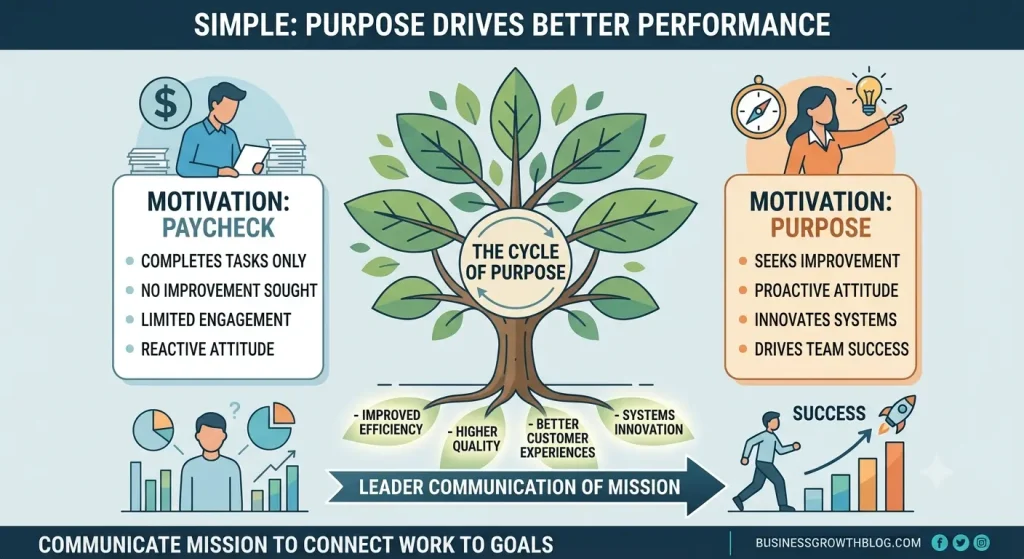
An employee whose only motivation is earning a paycheck may complete assigned tasks without seeking improvement.
In contrast, someone who genuinely wants to help the organization succeed naturally looks for better systems, higher quality, improved customer experiences, and increased efficiency.
Purpose influences attitude.
Attitude influences performance.
Performance influences business success.
Leaders should consistently communicate the organization’s mission so employees understand how their work contributes to larger business goals.
Stop Solving Every Problem
One of the biggest mistakes executives make is solving every problem presented by their team.
Although this may appear helpful, it unintentionally creates dependency.
Instead of immediately providing solutions, leaders should encourage employees to think critically.
Questions such as:
- What do you think caused the problem?
- What solutions have you considered?
- Which option would produce the best outcome?
- What data supports your recommendation?
These questions develop problem-solving ability and prepare employees for future leadership positions.
Executives build organizations by developing thinkers—not followers.
Move from Technician to Executive
Many business owners remain trapped because they continue working as technicians inside their own companies.
They answer customer calls.
Approve every decision.
Solve every operational problem.
Handle every difficult client.
Review every task personally.
While these activities may feel productive, they prevent business growth.
An executive focuses on:
- Business strategy
- Leadership development
- Removing bottlenecks
- Monitoring KPIs
- Improving systems
- Coaching managers
- Expanding opportunities
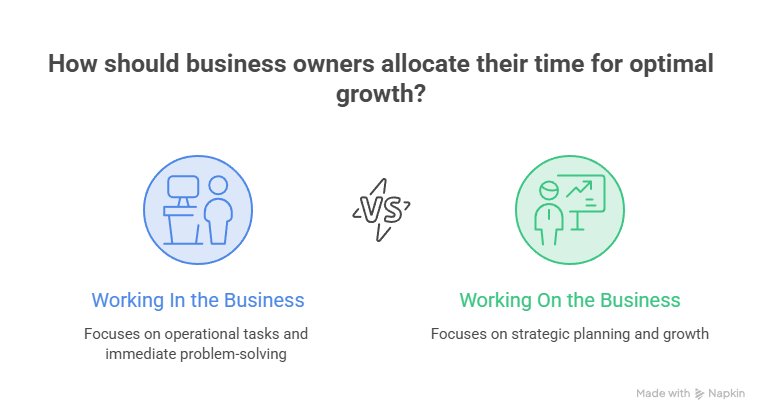
Working on the business creates growth.
Working in the business eventually limits it.
Build a Business That Runs Without You
The ultimate objective of delegation is creating a business that continues operating efficiently whether the owner is present or not.
This requires documented systems, capable leaders, measurable performance standards, and a culture of continuous improvement.
Businesses that depend entirely on one person rarely achieve sustainable growth.
Businesses built on leadership and systems continue expanding year after year.
Final Thoughts
Executive delegation is one of the most valuable skills any business owner can develop. It transforms organizations from owner-dependent operations into scalable businesses capable of sustained growth.
By documenting processes, developing people, measuring performance, and empowering employees to think independently, executives create stronger teams and free themselves to focus on strategic leadership.
If you want to take your business to the next level, begin by asking yourself one important question:
What responsibilities can I successfully document, delegate, and develop in someone else today?
The answer to that question often determines how quickly your business will grow tomorrow.
Frequently Asked Questions
1. What is executive delegation?
Executive delegation is the process of transferring responsibility, authority, and accountability for specific tasks or roles to qualified team members. It allows executives to focus on strategic leadership while empowering employees to take ownership of operational responsibilities.
2. Why is delegation important for business growth?
Delegation helps businesses grow by freeing leaders from day-to-day operational tasks so they can focus on strategy, leadership development, system improvement, and expansion. It also develops employee skills and increases organizational efficiency.
3. How can executives delegate tasks effectively?
Effective delegation involves documenting procedures, selecting the right person, providing structured training, establishing clear performance metrics, offering ongoing coaching, and empowering employees to make decisions while remaining accountable for results.
4. What are the biggest mistakes executives make when delegating?
Common delegation mistakes include failing to document procedures, micromanaging employees, choosing the wrong person for the role, solving every problem instead of coaching staff, and neglecting ongoing training and performance measurement.
5. How does delegation help executives become better leaders?
Delegation allows executives to shift from performing operational work to focusing on leadership, strategic planning, business growth, and team development. It builds stronger leaders within the organization and creates a business that can operate successfully without relying on one individual.
Every successful business reaches a point where the next stage of growth requires a new perspective, better systems, and a clear strategy. Whether you’re looking to increase profits, improve operations, strengthen your team, or build a business that can thrive without depending on you every day, we’re here to help.
At SBM Business Centers, we don’t believe in one-size-fits-all solutions. We take the time to understand your business, identify opportunities for improvement, and provide practical strategies you can implement immediately.
Schedule your complimentary Business Analysis and Consultation today. To schedule your free consultation, contact Vida Puodziunas at 813-906-0477. We look forward to helping you build a stronger business and a brighter future.