

There are thousands of mistakes a business owner could make. Poor hiring, weak financial management, ineffective marketing, and bad decisions can all create serious problems.
But one of the most dangerous—and often overlooked—is business complacency.
Complacency can appear after success, not just failure.
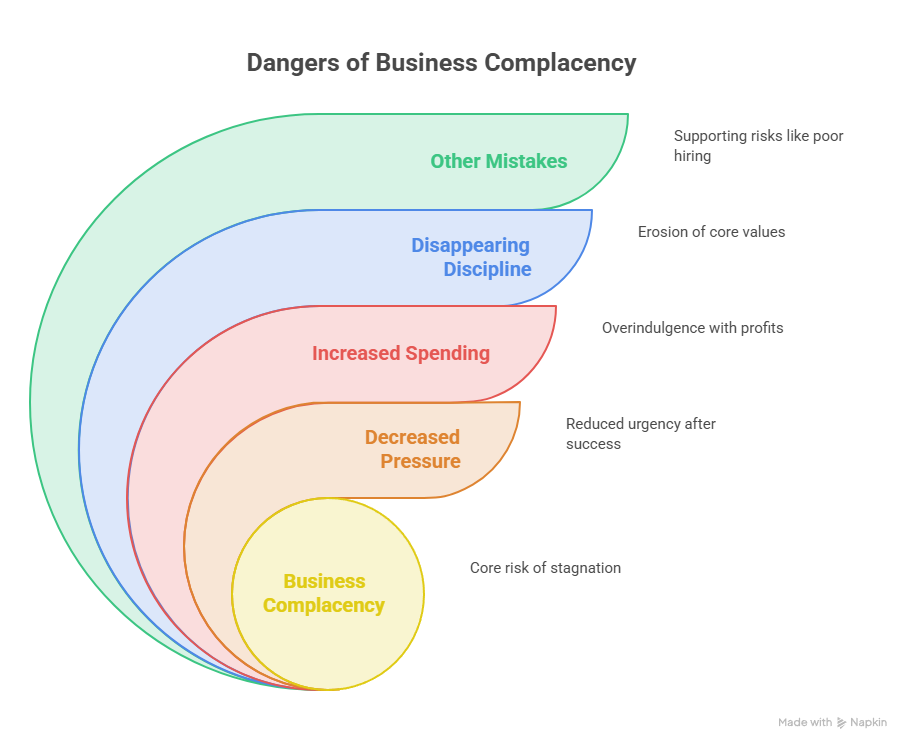
A company may reach a level of profitability it has never experienced before. The owner feels comfortable. The pressure decreases. Vacations become longer, spending increases, and the discipline that originally built the company slowly disappears.
At first, nothing seems wrong.
Then growth slows.
Performance declines.
Key employees leave.
Expenses increase.
Customers begin to notice.
Eventually, a business that once appeared unstoppable can find itself struggling to regain momentum.
The lesson is simple:
Success should create new goals—not an excuse to stop growing.
What Is Business Complacency?
Business complacency occurs when an owner or leadership team becomes overly comfortable with current results and stops actively looking for ways to improve.
It can appear in subtle ways:
- Assuming existing customers will always remain loyal
- Stopping innovation
- Reducing employee development
- Ignoring changing market conditions
- Spending profits without a strategic plan
- Taking success for granted
- Avoiding difficult decisions
- Becoming less involved in important business activities
- Assuming yesterday’s strategy will continue working tomorrow
The danger is that complacency rarely feels dangerous while it is happening.
It often feels like “We’ve finally made it.”
That mindset can become the beginning of decline.
Why Success Can Create Complacency
When entrepreneurs build a business from the ground up, they often operate with tremendous focus.
They watch expenses.
They talk to customers.
They solve problems.
They work long hours.
They constantly look for opportunities.
They develop employees.
They make decisions quickly.
That intensity can produce significant business growth.
But once the business reaches a comfortable level of success, the motivation can change.
The owner may begin thinking:
“We’ve made it. We can relax now.”
Relaxation itself isn’t the problem.
Everyone needs rest.
The problem occurs when rest replaces purpose, discipline, and strategic direction.
A business still requires leadership even when it becomes profitable.
The Hidden Danger of Achieving Your Goal
One of the most interesting causes of complacency is actually achieving the original goal.
Consider an entrepreneur who starts a restaurant with a simple objective:
“I want to build a restaurant that provides a good living for my family.”
Five years later, the restaurant is profitable, and the owner is earning the comfortable income they originally wanted.
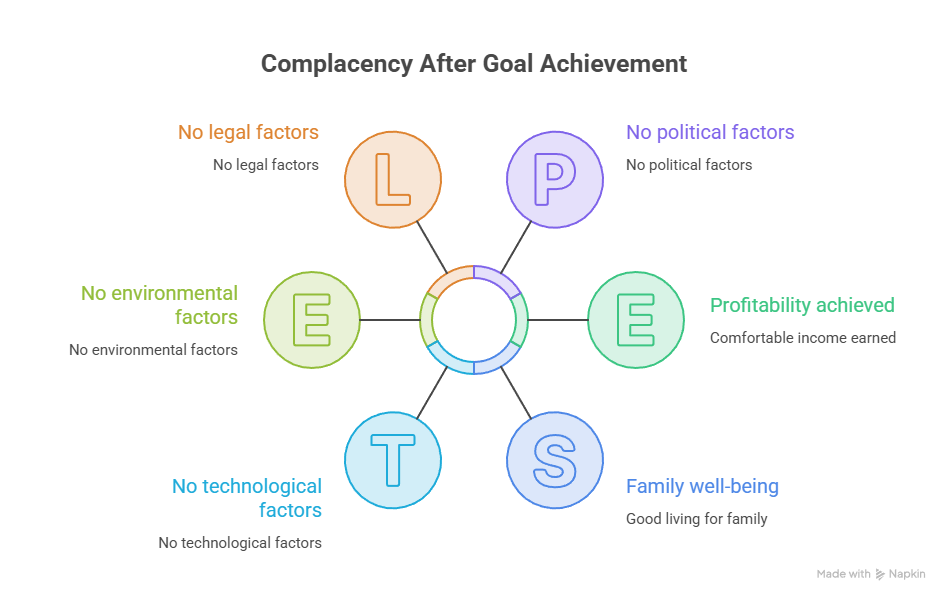
The goal has been achieved.
But they may not consciously recognize it.
Instead of setting a new objective, they become bored.
They purchase expensive personal assets.
They spend less time at the restaurant.
They stop looking for ways to improve the operation.
Eventually, the business begins to suffer.
A manager leaves.
Customer service declines.
Expenses increase.
Sales fall.
The owner suddenly finds themselves working hard again to maintain the lifestyle they had previously achieved.
This is a classic example of why long-term business growth requires continually renewing your goals.
The Solution: Set Bigger and More Meaningful Goals
The solution isn’t to work endlessly or refuse to enjoy the rewards of success.
The solution is to establish dynamic goals that evolve as the business develops.
A goal such as:
“I want to make a comfortable living.”
may be useful during the startup phase.
But what happens after you achieve it?
You need another destination.
A stronger long-term goal might be:
- Build multiple locations
- Develop future leaders
- Create 100 jobs
- Expand into new markets.
- Develop new products
- Build a company that operates without constant owner involvement.
- Create opportunities for employees.
- Develop systems that improve customer experiences.
- Build an organization capable of serving thousands of customers.
These goals provide a reason to keep improving.
Don’t Make Money the Only Goal
Making money is not inherently wrong.
Profit is necessary for business sustainability.
A profitable company can invest in employees, technology, marketing, research, expansion, and better customer experiences.
The problem occurs when money becomes the only purpose.
Money can provide comfort, but comfort alone may not provide direction.
Once a person has achieved the financial target they originally wanted, they may suddenly find themselves asking:
“What am I working toward now?”
That question can expose an underlying lack of purpose.
A more sustainable approach is to make financial success part of a larger mission.
For example:
“We want to build the most reliable service company in our market while creating career opportunities for our employees and delivering exceptional results for customers.”
Revenue and profit become measurements that help support the mission.
They aren’t the entire mission.
Use Boredom as a Warning Signal
Boredom can be an important signal for an entrepreneur.
When you begin thinking:
- “I’ve done this already.”
- “There’s nothing new to accomplish.”
- “The business runs itself.”
- “I don’t really care about improving this anymore.”
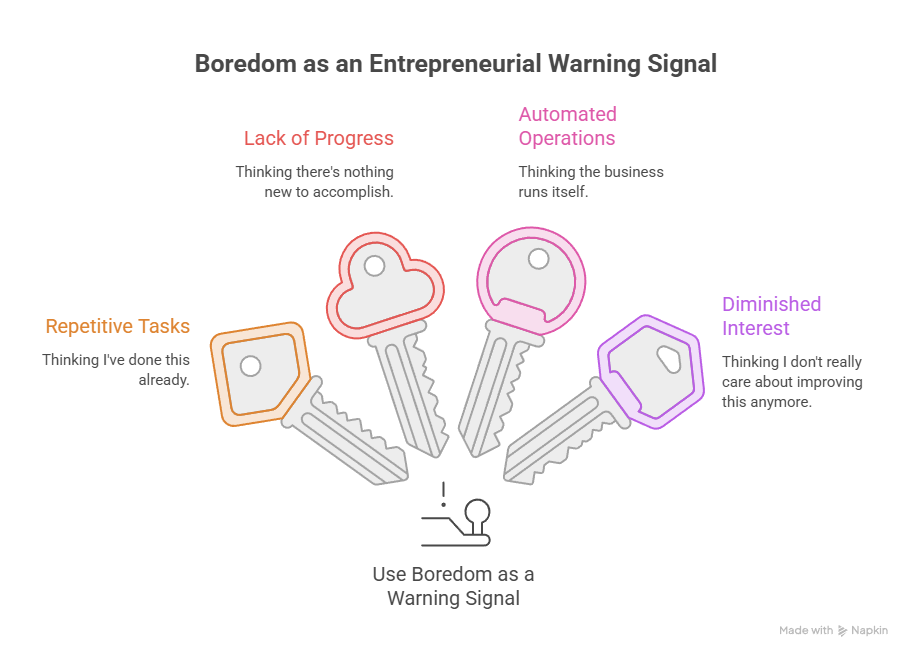
Don’t automatically assume you need to exit the business.
Ask a more important question:
“Have I achieved the goal that originally motivated me?”
If the answer is yes, you may not have a business problem.
You may have a goal problem.
Your original objective may be complete.
The solution could be to create a new challenge.
A Goal Audit for Business Owners
If your business has begun losing momentum, conduct a goal audit.
Ask yourself the following questions:
1. Why Did I Start the Business?
Go back to the beginning.
What did you originally want to accomplish?
Don’t only look for formal business plans.
Think about the conversations, ideas, ambitions, and motivations you had when you started.
2. What Goal Have I Already Achieved?
Identify the original result you were trying to create.
It could have been:
- Financial independence
- A comfortable lifestyle
- Owning your own company
- Creating a specific product
- Leaving employment
- Supporting your family
- Building a professional reputation
3. Has That Goal Already Been Achieved?
Be honest.
Sometimes entrepreneurs keep operating under an old objective long after they have accomplished it.
4. What Is the Next Meaningful Goal?
Create a new objective that challenges you and creates value.
5. Who Benefits From the New Goal?
The strongest goals often extend beyond personal comfort.
Consider customers, employees, partners, communities, or other people who can benefit from the company’s continued growth.
Build Goals That Create Momentum
Effective goals should be challenging enough to keep the organization moving forward without becoming unrealistic.
A useful framework is to create goals across several areas.
Financial Goals
Examples:
- Increase revenue
- Improve profitability
- Build cash reserves
- Reduce unnecessary debt
- Invest in expansion
Customer Goals
Examples:
- Improve customer satisfaction
- Increase retention
- Expand into new markets.
- Develop new solutions
Employee Goals
Examples:
- Develop future leaders
- Improve training
- Create career pathways
- Strengthen company culture
Operational Goals
Examples:
- Improve efficiency
- Automate repetitive tasks
- Document systems
- Reduce errors
- Improve quality control
Strategic Goals
Examples:
- Launch a new division.
- Open another location
- Develop a new product.
- Establish strategic partnerships
- Build a business that operates independently of the owner.
This creates a balanced approach to business growth.
Don’t Confuse Rest With Complacency
There is an important distinction between taking a break and becoming complacent.
Rest restores energy.
Complacency reduces ambition and awareness.
A business owner can take a vacation and still have strong goals, systems, leadership, and accountability.
The problem isn’t taking time away.
The problem is losing interest in the business while failing to replace the original purpose with a new one.
A healthy business should be able to operate without its owner being involved in every task.
The objective should be to build systems and leaders—not to create an organization that depends entirely on the owner’s constant presence.
Keep Improving Even When Business Is Going Well
One of the best ways to prevent complacency is to make continuous improvement part of the company’s culture.
Ask regularly:
What could we do better?
Review:
- Customer feedback
- Employee feedback
- Financial performance
- Sales trends
- Operational efficiency
- Competitor activity
- New technology
- Market changes
- Product performance
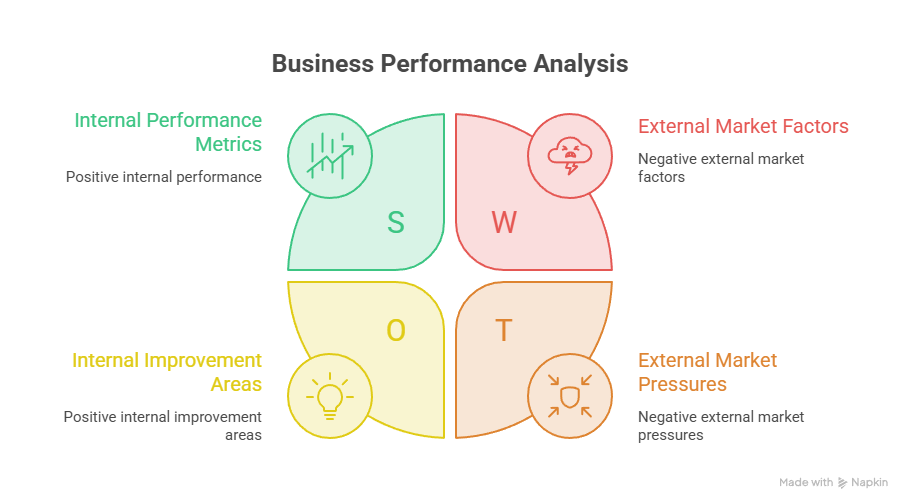
Don’t wait for a crisis to force you to improve.
Improvement is easier when the business is healthy.
The Long-Term Growth Mindset
Don’t build a business around one destination.
Think of growth as a series of stages.
Goal → Achievement → New Goal → Expansion → New Challenge
When you achieve one objective, celebrate it.
Then ask:
“What’s next?”
This doesn’t mean constantly chasing more money.
It means continually finding ways to create more value, develop people, improve the organization, and pursue worthwhile challenges.
What to Do When Your Business Starts Declining
If you notice declining revenue, falling customer engagement, employee turnover, or reduced motivation, don’t immediately assume that external circumstances are responsible.
Conduct an internal review.
Ask:
- What has changed?
- When did performance begin declining?
- What was happening immediately before the decline?
- Have our goals changed?
- Have we achieved our original objective?
- Has leadership become less engaged?
- Have we stopped innovating?
- Are our systems still effective?
- Have customer needs changed?
- What new goal could restore our sense of purpose?
These questions can reveal whether the business needs a tactical adjustment—or a completely new direction.
The One Thing You Mustn’t Do
The one thing you mustn’t do is become so comfortable with success that you stop creating new reasons to succeed.
Enjoy the rewards of your work.
Take time off.
Spend money responsibly.
Celebrate achievements.
But don’t abandon the purpose, discipline, and curiosity that created the business in the first place.
When you achieve your original goal, recognize it.
Then establish a new one.
Final Thoughts
Business complacency doesn’t always begin with failure. Sometimes it begins with success.
An entrepreneur achieves the goal they originally set, becomes comfortable, and unknowingly loses the sense of purpose that drove the company’s early growth.
The answer isn’t to work harder simply for the sake of working harder.
The answer is to create a meaningful new direction.
Set bigger goals.
Build stronger systems.
Develop your people.
Create better products and services.
Serve more customers.
Continue learning.
Most importantly, understand that achieving a goal should not be the end of the journey.
It should be the starting point for the next one.
Frequently Asked Questions About Business Complacency
What is business complacency?
Business complacency is the tendency for owners or leadership teams to become overly comfortable with existing results and reduce their focus on improvement, innovation, planning, and growth.
Why is complacency dangerous for a business?
Complacency can cause businesses to overlook changing customer needs, competitors, operational problems, employee issues, and emerging opportunities. Small problems can become much larger when they are ignored.
Can success actually cause business complacency?
Yes. Success can create a false sense of security. When a business reaches a comfortable level of profitability, the owner may reduce their attention to growth, systems, customers, and strategic planning.
How can I tell if my business has become complacent?
Warning signs include declining motivation, reduced innovation, stagnant revenue, increasing expenses, employee turnover, declining customer satisfaction, avoiding difficult decisions, and a lack of meaningful future goals.
What should I do if I have already achieved my original business goal?
Recognize the achievement and establish a new meaningful goal. Consider expanding your customer base, developing employees, launching new products, entering new markets, improving systems, or creating a larger impact.
Should making money be the primary goal of a business?
Profit is essential for a sustainable business, but making money alone may not provide enough long-term direction. A stronger approach is to combine financial objectives with goals related to customers, employees, innovation, service, and organizational growth.
How can I maintain long-term business growth?
Maintain a continuous improvement mindset. Regularly review your goals, financial performance, customer needs, employees, systems, and market conditions. Set new objectives as you achieve previous goals.
Is taking a vacation a sign of complacency?
No. Rest and recovery are important. Complacency occurs when reduced activity is accompanied by a loss of purpose, awareness, accountability, or commitment to the business’s long-term direction.
What role does goal setting play in preventing complacency?
Goal setting provides a continuing sense of direction. When a goal is achieved, establishing the next meaningful objective can help maintain motivation, innovation, and organizational momentum.
What is the biggest lesson about avoiding complacency?
Don’t assume that reaching a comfortable level of success means the work is finished. Achieving one goal should lead you to evaluate what comes next. Continuous learning, meaningful goals, and purposeful improvement help keep a business moving forward.
If you have any questions about anything covered here, reach out to Vida Puodziunas at 813-906-0477. We’re also happy to provide a free business analysis to show you exactly where the opportunities are and how we can help your business expand.